
Author: Nancy, PANews
Following the U.S. GENIUS Act’s implementation in July, Circle—the so-called “first stablecoin IPO”—recently released its first quarterly financial report under the new regulatory framework. Although revenue slightly exceeded expectations, its stock price declined, driven by concerns over Circle’s overly concentrated profit structure, low-quality earnings, downward pressure on interest rates, and a large volume of shares scheduled to unlock soon—raising short-term market anxiety. Nevertheless, Circle is actively cultivating a second growth curve through new initiatives—including its Arc Layer-1 blockchain and the tokenized money market fund USYC—to diversify revenue streams and reduce its dependence on interest income.
USDC Carries the Revenue Flag, While Distribution Costs Further Erode Profit Margins
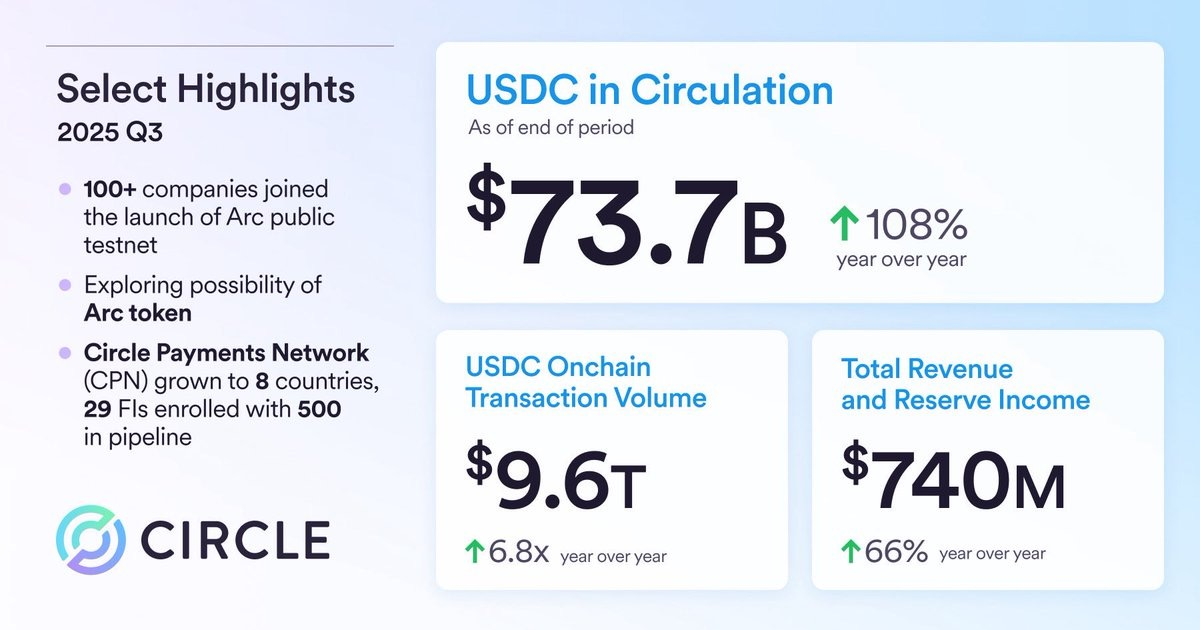
Circle’s latest financial report shows total quarterly revenue approaching $740 million, of which $711 million came from USDC reserve income—a 60% year-on-year increase—accounting for 96.1% of total revenue (slightly down from last year), making it Circle’s absolute core revenue source. This growth stems primarily from USDC’s accelerating market adoption: its circulating supply reached $73.7 billion, with average circulation up 97% year-on-year, and its market share rose from ~22.6% to 29%. The company projects USDC’s long-term compound annual growth rate (CAGR) at 40%, indicating a degree of sustainability in revenue growth.
In contrast, other revenue sources contributed less than 4% (~$28.51 million), mainly from subscriptions, APIs, and payment network services—but grew over 52x year-on-year. Circle has accordingly raised its full-year guidance for this segment to $90–100 million. However, in the near term, these contributions remain limited in their impact on overall revenue—meaning Circle’s income structure remains highly concentrated and extremely sensitive to interest rate fluctuations. Markets widely expect the Federal Reserve to cut rates by another 25 basis points at its December meeting; meanwhile, Circle’s reserve return rate this quarter fell by 96 bps to 4.15%. Should interest rates continue declining, Circle’s interest income could face further compression, exerting clear pressure on overall profitability.
On the profitability front, Circle posted a net profit of $214 million this quarter—successfully reversing the massive loss incurred in Q2 due to IPO-related expenses—and marking a 202% year-on-year increase. However, excluding a $56.21 million gain from the decline in fair value of convertible debt and a $61.29 million tax benefit (attributable to stock-based compensation, R&D tax credits, and impacts from new tax legislation), underlying operating profit stood at approximately $96.5 million. In other words, only about 45.1% of Circle’s net profit this quarter was generated from core operations—significantly diminishing its true earnings quality.
Notably, USDC’s rapid growth has been fueled by Circle’s aggressive, “spend-to-grow” distribution partnership model—a strategy that has also become a drag on performance. This quarter, Circle spent $447 million on distribution and transaction costs—roughly 62.8% of reserve income, up from 42% in Q3 2024. The company attributes this rise to increased USDC on-chain balances, higher average Coinbase holdings, and expanded strategic partnerships. Meanwhile, Circle’s retained income as a share of reserve income dropped to 37% this quarter, down from 42% a year ago—indicating distribution cost growth outpaced revenue growth. Regarding the decline in RLDC (Revenue Less Distribution Costs), Circle stated on its earnings call that prioritized partner distribution incentives and dynamic market rewards drove rising costs, but economies of scale will improve leverage, with full-year RLDC gross margin expected at ~38%.
On the other hand, Circle’s operating expenses totaled $211 million this quarter—a 70% year-on-year increase—driven largely by higher compensation (including $59.08 million in stock-based compensation) and rising IT, administrative, and R&D expenditures. Circle has also raised its full-year adjusted operating expense forecast to $495–510 million, citing increased investment in platform capabilities and global partner expansion.
Overall, Circle continues to post strong growth in its USDC reserve business, yet faces constrained profit margins, while diversified revenue streams have yet to provide meaningful support. This has triggered market concerns: CRCL has fallen to $86.30, down ~12.2% currently and ~64.1% from its all-time high. Meanwhile, Circle faces a major share unlock event on November 14. As disclosed in its IPO prospectus, locked shares will become eligible for sale either 180 days after listing or on the second trading day following public disclosure of its Q3 financial results—whichever occurs earlier—potentially intensifying selling pressure and adding further volatility to its stock price.
Building a Second Growth Curve: Circle’s Three Strategic Moves
As more stablecoin newcomers enter the space, competition is intensifying. Under this trend, distribution capability and ecosystem expansion have emerged as new core competitive dimensions—supplanting early-mover advantage and regulatory compliance as sole differentiators. To this end, Circle continues expanding the cooperative ecosystem around its flagship product, USDC.
According to the earnings report, since Q2, Circle has announced several key USDC-related partnerships—including Brex, Deutsche Börse Group, Finastra, Fireblocks, Hyperliquid, Kraken, Itaú Unibanco, and Visa—spanning enterprise payments, traditional finance, custody, DeFi, and cross-border payments. These efforts are accelerating Circle’s deep integration into mainstream financial infrastructure.
At the same time, to quickly mitigate risks tied to overreliance on USDC issuance for profitability, Circle is accelerating its push toward revenue diversification.
First, Circle is entering the foundational infrastructure layer. In August, the company launched Arc—the first Layer-1 blockchain developed in-house. On October 28, the Arc testnet officially went live, attracting participation from over 100 institutions across capital markets, banking, asset management, insurance, payments, and technology sectors. Circle aims to provide developers and enterprises with programmable financial infrastructure to scale onchain economic activity. Additionally, Circle plans to explore issuing an Arc-native token to incentivize network participation, drive ecosystem application deployment, and build a sustainable long-term network economy.
Second, Circle continues deepening its footprint in payments and settlement. In May, the company launched its cross-border payment network, Circle Payments Network (CPN). CPN now covers eight countries, with 29 financial institutions officially onboarded, another 55 under review, and 500 still awaiting access. As of November 7, 2025, CPN’s annualized transaction volume over the past 30 days reached ~$3.4 billion.
Third, tokenized assets have become a key focus area. Mid-year, Circle launched USYC—a tokenized money market fund—designed to offer institutional and high-net-worth investors a tradable, liquid, yield-stable digital asset instrument. From June 30 to November 8, 2025, USYC’s assets under management grew over 200%, reaching ~$1 billion.
Overall, although Circle’s business continues to grow steadily, short-term profitability faces mounting pressure. The company is proactively expanding beyond stablecoins—transitioning rapidly from a stablecoin issuer to a comprehensive onchain financial infrastructure provider. Yet in the fiercely competitive stablecoin arena, this transformation won’t be easy.