
Author: Nancy, PANews
As October drew to a close, publicly traded companies began unveiling their third-quarter results. U.S. "meme broker" Robinhood delivered an earnings report that beat expectations, with both revenue and profit reaching record highs. This signals early success for its diversification strategy and accelerates its transformation into a full-fledged fintech company. Despite the strong financials, Robinhood's stock price dipped following the report's release.
Crypto Trading Drives Core Growth; Prediction Markets Emerge as New Engine
Robinhood posted impressive numbers for Q3 2025. Total platform revenue hit $1.27 billion, a 100% increase year-over-year; net income reached $556 million, up 271% YoY; and diluted EPS came in at $0.61, surging 259% YoY. The platform also added 2.5 million funded accounts this quarter, bringing its total to 26.8 million. The data suggests that years after the initial wave of commission-free trading, Robinhood has clearly found a new growth trajectory—evolving from a single-purpose trading app into a diversified fintech group.
Despite robust growth, the results slightly missed market expectations, and the subsequent stock decline reflects investor concerns about the sustainability of future profits.
Breaking down the revenue, Robinhood's income currently comes from trading revenue (57%), net interest income (36%), and subscription and other revenue (7%). Notably, crypto trading was the core growth driver this quarter. Crypto-related revenue soared to $268 million, up over 300% YoY, accounting for more than one-third of total trading revenue.
This year, Robinhood expanded its crypto footprint by acquiring exchange Bitstamp and partnering with prediction market platform Kalshi—key moves behind this quarter's revenue surge. Crypto trading is now one of Robinhood's major business lines, generating over $100 million in annualized revenue. The crypto market rebound fueled activity from both retail and institutional traders; Bitstamp's integration added institutional and derivatives volume; and the launch of prediction markets attracted a flood of new users—all combining to boost crypto trading revenue. However, crypto revenue still fell short of the market's $287.2 million expectation.
Bitstamp's integration significantly boosted trading volume. According to the report, Robinhood's nominal crypto trading volume in October exceeded $32 billion, with Bitstamp contributing $18 billion (primarily from institutional trading). Moving forward, Bitstamp will serve as Robinhood's main platform for rolling out tokenized stock offerings. That said, while Bitstamp dramatically increased overall volume, its relatively low fee structure limited its actual revenue contribution—raising market concerns about sustainable revenue growth.
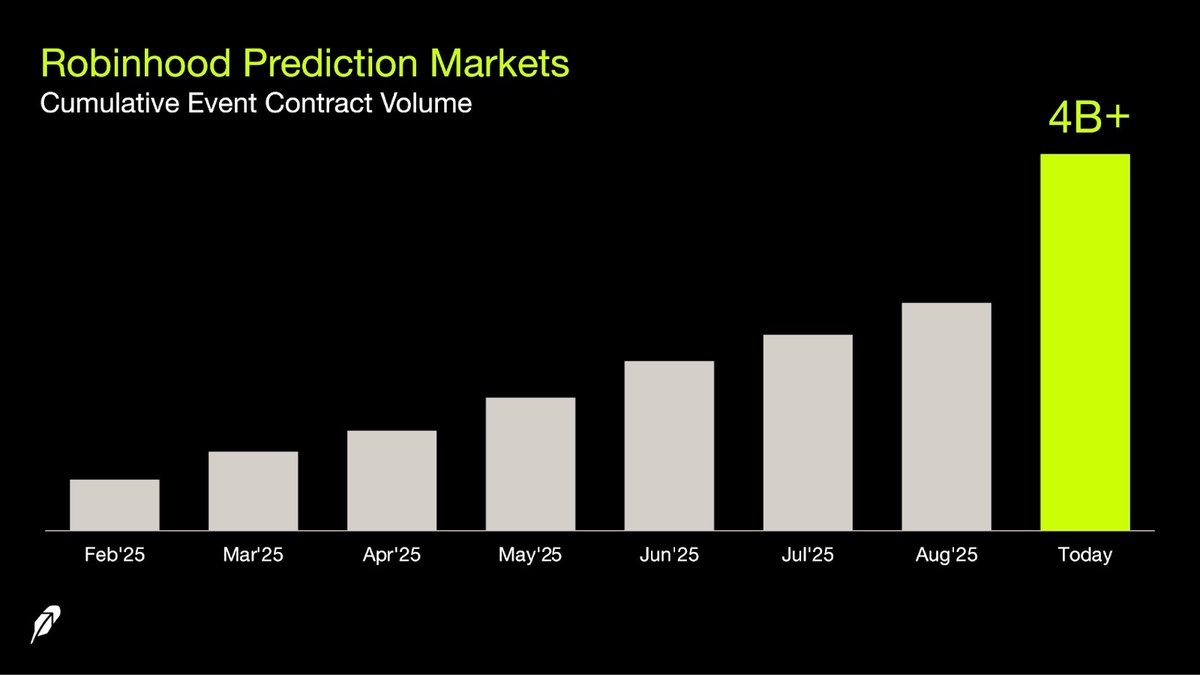
Meanwhile, prediction market activity exploded. In Q3, Robinhood's prediction contract trading volume doubled sequentially to 2.3 billion contracts (each valued at $1), making it the platform's third most-traded product category after stocks and options. In October alone, trading volume hit $2.5 billion, with the platform expected to generate roughly $25 million in revenue from this segment that month.
Beyond crypto and prediction markets, Robinhood's stock trading revenue rose 132% YoY, and options trading revenue grew 50% YoY. However, these trading businesses are widely seen as highly cyclical. Charles Bendit, an analyst at Rothschild & Co Redburn, assigned Robinhood a "sell" rating. He acknowledged the company's strong product execution but warned that current results may represent a cyclical peak, while its market valuation implies unproven long-term stability.
A Top S&P 500 Performer This Year; Banking and Investment Plans Underway
In 2025, Robinhood became one of the best-performing stocks in the S&P 500, with its share price skyrocketing over 222% year-to-date—far outpacing the Nasdaq-100 Index. This stellar performance reflects not only market enthusiasm for Robinhood's growth story but also its consistently strong fundamentals.
Since initiating its share repurchase program in 2024, Robinhood has bought back approximately $810 million worth of shares. Additionally, CEO Vlad Tenev's long-term incentive plan—which granted each of Robinhood's two co-founders 13.8 million shares if the stock hit $101.50 per share by 2025—fully vested in Q3. His current annual cash compensation is just $40,000.
Robinhood's strong financial performance has also generated ample cash flow to fuel its diversified expansion. As of the end of Q3, Robinhood held $4.3 billion in cash and cash equivalents, with shareholder equity totaling about $8.57 billion. Adjusted operating expenses for full-year 2025 are projected at $2.28 billion—slightly above prior guidance—mainly due to higher employee bonuses from outperformance and continued investment in new businesses and technology. Although operating expenses rose 31% YoY in Q3, revenue doubled, allowing for sustained margin expansion.
Looking ahead, Robinhood remains optimistic about its financial outlook, citing an exceptionally strong start to Q4: October saw all-time highs for monthly trading volumes in stocks, options, prediction markets, and futures—and margin balances also reached a record. Robinhood now operates 11 business lines each generating $100 million or more in annualized revenue, with plans to launch additional asset classes.
"In terms of product vision, we aim to make Robinhood a household financial hub," Vlad Tenev revealed during the earnings call. He credited the company's significantly improved product execution and iteration speed to systematic adjustments made over the past few years in organization, culture, and technology—emphasizing "rapid product delivery" as a core goal. Multiple business lines are now being aggressively pushed forward.
For instance, in the prediction business, Robinhood's prediction markets division is in rapid expansion mode, having already launched over 1,000 contracts covering sports, finance, entertainment, culture, and technology. The company is engaging with overseas regulators—including the UK's Financial Conduct Authority (FCA)—to explore launching offshore prediction markets outside the U.S.
On the banking front, Robinhood Banking is being rolled out in phases, aiming to become users' go-to platform for direct deposit and payroll through a diversified suite of financial products and services.
Regarding investments, the company is preparing to launch Robinhood Ventures and has already filed relevant documents with the U.S. Securities and Exchange Commission (SEC). The focus will be on investing in innovative projects to bring new growth engines to the platform.
Additionally, for tokenized stocks, Robinhood has launched related offerings in over 30 countries and expanded its product range to more than 400 instruments. Next steps include rolling out tokenized stock trading on the Bitstamp platform and integrating with the DeFi ecosystem.
Beyond the U.S., Robinhood is planning international expansion, targeting a future where non-U.S. markets and institutional clients contribute over 50% of total revenue—reducing its current heavy reliance on retail business. While Robinhood prefers organic growth, it hasn't ruled out acquisitions. International expansion remains in its early stages.