
Between 2019 and 2020, the total USD trading volume of NFTs nearly tripled. According to market analytics firm DappRadar, NFT sales surpassed $1.5 billion in Q1 2021—a staggering 20-fold increase from Q4 2020—marking the most explosive period in NFT history to date. Record-shattering, multimillion-dollar auctions repeatedly captured public attention, igniting the entire industry and propelling NFTs into the mainstream.
NFT Categories and Development
Since their inception, NFTs have matured into a robust tech stack, with application-layer use cases rapidly expanding across diverse fields. Today, six primary categories have taken shape: Art, Collectibles, Virtual Worlds, Gaming, Utility, and Sports.
As the charts below illustrate, Collectibles, Virtual Worlds, and Gaming dominated the NFT landscape in 2020. By Q1 and Q2 2021, Collectibles and Art captured the lion’s share of the market, while Sports steadily gained ground—rising from 3% to 7%—and continues on an upward trajectory.
Fervent Expectations for the 2021 Sports Year
The fusion of art and technology is nothing new, and NFTs represent a natural evolution of this trend. Numerous mature projects have already emerged at the intersection of NFTs with Collectibles or Art. Meanwhile, the intense passion surrounding live sports and fan culture points to immense untapped potential in the sports sector. Industry players have seized this opportunity, entering the NFT space in force. Since the first sports-themed NFT projects launched in 2018, over $85 million in sales have been generated from 480,000 items, with 18 million active wallets.
As the chart below shows, NFTs began entering mainstream consciousness in Q4 2020, coinciding with the rise of the NFT + Sports vertical. Sales surged dramatically, peaking in March 2021. Overall, Q1 2021 recorded the highest quarterly sales, followed by a slight dip in Q2—though both quarters remained far above pre-2020 levels, stabilizing at a substantial volume.
Why has the NFT + Sports segment grown so explosively? Much of it can be tied to the heightened anticipation for the 2021 sports calendar. Originally expected to be a relatively quiet year, 2021 unexpectedly became a once-in-a-generation "mega-year" due to pandemic-related postponements. Beyond annual staples like the NBA, Europe’s top football leagues, Formula 1, and the NFL, major global events including the Tokyo Olympics, UEFA European Championship, Copa América, and China’s National Games were all rescheduled for 2021. With the most congested sports calendar ever, 2021 was destined to be a year of unprecedented fan engagement.
2021 Sports Calendar
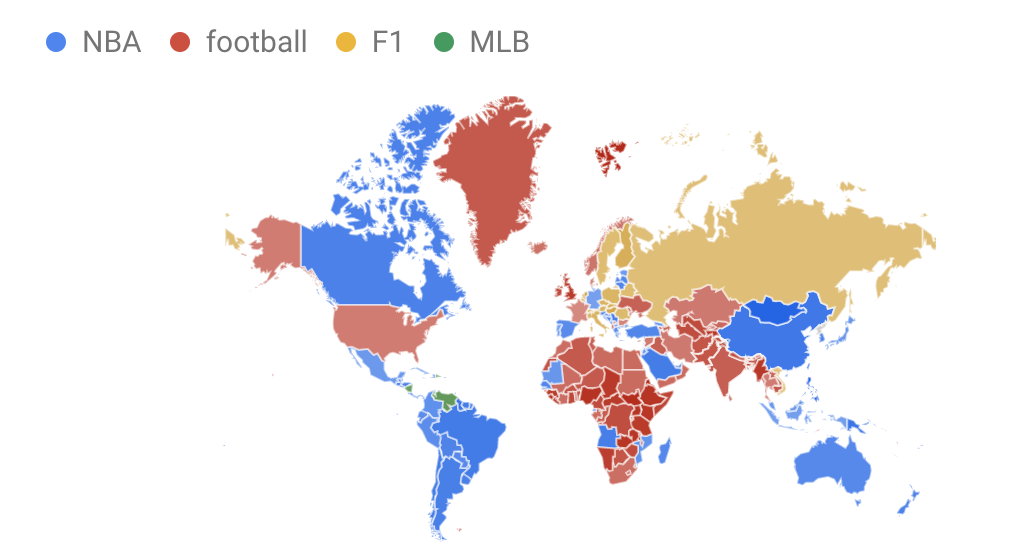
Based on Google keyword search trends from 2020–2021, global interest in basketball and football far outpaces motorsports and baseball—and spans virtually every continent. In contrast, motorsports and baseball enjoy more localized popularity. On social media, the NBA commands significantly greater visibility than football (soccer), Major League Baseball (MLB), or American football, boasting over 1 billion fans worldwide.
Within the NFT + Sports ecosystem, two main project categories have emerged:
First, NFTs integrated with sports intellectual property (IP), including both live-event IP and sports-gaming IP. Football-focused initiatives are the most numerous among live-event IP projects, while other sports remain more fragmented. Notable examples include Sorare, NBA Top Shot, REVV, and ZED Run. Within sports-gaming IP, Fantasy Sports stands out, with related projects such as blockchain gaming platform Rage.Fan and decentralized sports trading platform TradeStars.
Second, comprehensive NFT sports application platforms—including Chiliz (redefining sports fandom economics), OpusBeat (a competitive sports auction platform), SportsIcon (a sports-athlete collectibles platform), and Blocksport (an esports club app service platform).
Sports NFT collectibles have secured a prominent position within the broader NFT collectibles category. As of early July, NBA Top Shot ranked #1 in sales, totaling over $600 million—with peaks exceeding $200 million in both February and March 2021, and a single-day record of $45.77 million.
NBA Top Shot shares its founding team—Dapper Labs—with CryptoKitties, the project that first brought NFTs to mainstream attention. It also runs on Flow, the public blockchain whose native token surged 3,000% at launch. Dapper Labs brings considerable operational expertise to the table.
Sorare ranks #7 with over $50 million in total sales; Topps sits at #12 with $14 million; F1 Delta Time ranks #17 with $5.24 million.
According to CoinGecko data, the combined market cap of the top 10 NFT tokens rose sharply in the first half of 2021. Chiliz (CHZ), the leading NFT + Sports token, saw modest growth in Q1, then surged dramatically in April and May before dipping slightly in Q2. CHZ currently holds the #3 spot among the top 10 tokens by market cap, reaching $1.2 billion.
NFT + Sports: The Strong-IP Fan Economy
Fan economies have proven to be powerful wealth engines: highly engaged fans are willing to pay a premium to support their idols—a norm not only in pop culture but especially in sports, where passion runs deep. NBA Top Shot is a prime example, alongside Sorare and Chiliz.
At its heart, NFT + Sports IP represents an "ownership economy." What value does an intangible, digital collectible hold? For fans, the thrill of ownership often outweighs physical possession. For instance, NBA Top Shot packages highlight clips of iconic NBA moments—"officially licensed by the NBA and minted as limited editions on the blockchain." Fans willingly pay thousands of dollars for these digital mementos. When a player goes viral or retires, these NFTs can appreciate instantly—leading many to believe current valuations are still undervalued. When an asset commands a sufficient premium, fan attention can sometimes eclipse personal affinity.
Younger consumers demonstrate upgraded purchasing power driven by deeper needs: blind-box mania reflects IP-driven identity affirmation; virtual-world participation satisfies desires for self-expression; personalized customization signals cultural distinctiveness; and cross-industry collaborations cater to diverse interests. The NFT + Sports convergence delivers precisely this: strong IP, immersive virtual experiences, unique scarcity, and multidimensional crossover appeal.
NFT + Sports IP Model Projects: Advantages include built-in fan bases, eliminating the need to start from scratch. The main disadvantage is heavy reliance on IP licensing; losing IP rights could erode fan loyalty. Thus, the critical success factor lies in converting fans into active participants in the NFT ecosystem—a challenge that demands exceptional marketing and operational skill.
NBA Top Shot Player Highlights
As the chart below shows, NBA Top Shot remains the top-selling collectible to date, with $6.89 million in sales. Sorare—another fan-economy-driven project—ranks #4 with $460,000 in sales.
Can NBA Top Shot’s success be replicated? Before the pandemic, the National Hockey League (NHL) generated nearly double the revenue of the NBA—but lagged far behind in social media engagement, allowing the NBA to capture first-mover advantage in NFTs. In 2021, the NHL actively pursued collaboration with Dapper Labs.
NFT + Sports: Utility and Use Cases
Sports clubs and leagues are integrating blockchain and NFTs through several approaches—often combining multiple methods in practice:
1. Issuing proprietary NFTs: Most teams release player cards on Sorare; many clubs and esports organizations issue NFTs via Socios.com.
2. Launching fan tokens: Socios.com—the world’s first tokenized voting platform, launched by Chiliz—is the leading fan-token issuer. Fans must first purchase CHZ tokens to redeem club-specific fan tokens. For example, AC Milan partnered with Chiliz to launch its ACM fan token on Socios.com.
3. Sponsorships and endorsements: Blockchain firms sponsor teams using cryptocurrency—though such deals may not involve NFT assets directly.
4. Technical partnerships: Teams collaborate with blockchain infrastructure providers for data services or ticketing systems. For instance, UEFA Euro 2020 named AntChain as its official global blockchain partner.
NFT + Sports use cases continue to evolve and currently include:
Purchasing, collecting, and reselling collectibles (e.g., player cards); auctioning collectibles; participating in gaming economies (buying in-game items, building teams, paying for match tickets); earning gameplay rewards (e.g., tournament prizes, game points); accessing VIP live experiences; participating in platform governance (e.g., voting); earning referral commissions; social media promotion rewards; staking yields; and mining incentives.
NFT + Sports Infrastructure and Economic Models
Some argue that NFTs function fundamentally as a protocol layer—or middleware—sandwiched between the application and infrastructure layers. NFT infrastructure remains limited, relying primarily on the ERC-721 and ERC-1155 standards (and minor variants), which suffice for basic needs but fall short for complex, interactive applications. As a result, most NFT + Sports projects remain at the level of static image/text displays or simple games.
Economically, most NFT + Sports projects feature rudimentary functionality and primitive incentive models—centered on native NFT utilities like display, trading, and staking. Cross-application composability—where NFTs generate value and earn rewards across multiple ecosystems—remains largely unexplored. While NFT marketplaces enable trading of individual assets, composite asset creation and value stacking are still underdeveloped. Today’s NFT + Sports assets either carry strong IP branding or serve as platform tokens—interoperable applications remain a distant possibility, constrained by foundational infrastructure limitations. Still, some projects are pioneering multi-faceted innovations: Rage.Fan, for example, introduced liquidity mining, expanded to multiple sports, and forged partnerships with clubs and leagues.
Will the Sector Rebound?
NFTs saw dramatic growth in Q1 2021—but not without speculative froth. Long-term, the sector must inevitably return to rational fundamentals—a trend already evident in Q2’s noticeable slowdown. NFT + Sports use cases remain sparse, and IP-driven economics face low technical barriers, increasing the risk of overvaluation. Even within the broader NFT ecosystem, NFT + Sports is still in its infancy—yet its potential is vast.
NFT value stems from the interplay of intrinsic value, utility value, and premium valuation. Currently, premiums are contracting. However, if underlying technologies mature and break new ground—enabling richer financial attributes and derivative capabilities—NFTs could build durable moats, minimizing disconnects with the physical world and curbing bubble formation. With growing numbers of clubs, teams, and star athletes entering this crypto-native arena and launching their own NFTs, the market size is already substantial. If momentum continues—if the market matures and NFT assets achieve mainstream adoption—a robust rebound may be closer than it seems.