

In economics, the terms "black swan" and "gray rhino" are often discussed together. A "black swan" describes a rare, unpredictable event with severe consequences, while a "gray rhino" refers to a highly probable, high-impact threat that is often ignored. In reality, most "black swan" events have their roots in neglected "gray rhinos."
When it comes to risk in the crypto market, a question often arises: Why do investors seem to overlook obvious dangers when the risks are already known? For instance, what's behind the massive issuance and premium pricing of USDT in today's market? Could the over-issuance of BTC on exchanges turn them into the ultimate sellers?
The answer is simple: financial markets tend to remain optimistic about crises that haven't materialized—especially those that are widely recognized but remain in a stalemate. As long as the situation doesn't worsen and investors aren't directly hurt, they rarely dig deeper. Most crypto investors are swayed by recent headlines rather than underlying fundamentals.
The growth of cryptocurrency and derivatives markets has even drawn traditional "HODLers"—who once simply bought and held—into popular derivatives and wealth management products.
Some of these products prioritize platform profits, luring users with promises of high returns while downplaying the risks—all to boost trading volume and sales. Lessons from past internet finance products show that some firms, in pursuit of maximum gain, have resorted to absconding or defaulting, leaving users exposed to significant losses.

Similar issues persist in today's crypto wealth management landscape. For example, the high-APY offerings on Binance Earn are nurturing a massive "gray rhino."
01
Binance's Massive Wealth Management Pool
High Caps Mask Looming Default Risk
In April, Binance Earn launched ultra-high-APY products, offering customized fixed-term options with 7-day and 30-day maturities. For instance, 7-day EOS products promised up to 6% APY, while 30-day products offered as much as 8%. Binance marketed these as delivering "returns 200% higher than comparable products."
Moreover, Binance raised individual subscription limits—from the industry standard of 2 BTC to 5,000 BTC per user, a cap worth roughly $47 million.
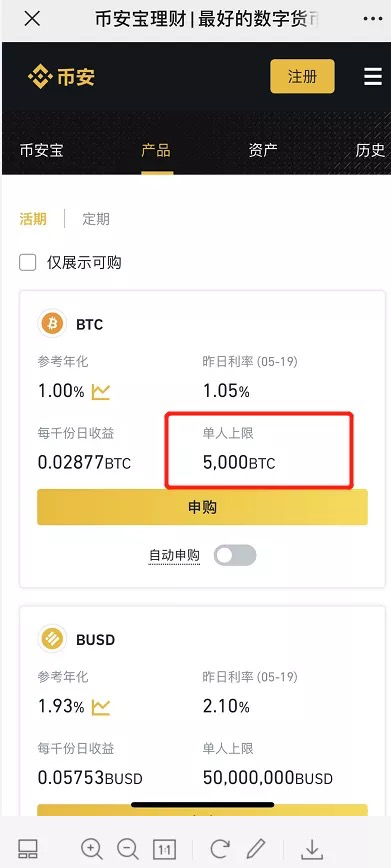
Screenshot of Binance Earn
While high-APY products may seem stable, crypto markets are far more volatile and risky than traditional ones. In truth, any product offering exceptionally high yields carries inherent default risk at maturity.
Now, Binance is attracting user deposits with APYs multiples above market rates, seemingly willing to risk default. This raises a red flag for seasoned investors: Is Binance's cash flow so strained that it needs to urgently raise funds from users to plug a liquidity gap?
So, how healthy is Binance's cash flow? Is it truly as solid as claimed? Answering this requires a multi-dimensional analysis of its annual revenue, expenses, and investment data.
02
BNB Buyback Data Reveals Inflated Profits
Since its founding in 2017, Binance has been a magnet for both praise and controversy.
BNB, Binance's native token, has a total supply of 200 million. Its original design stipulated that 20% of Binance's quarterly net profit would be used to repurchase and burn BNB until the supply is reduced to 100 million.

Undeniably, BNB's initial purpose was to drive price appreciation through buybacks and burns—benefiting all Binance investors. Today, however, BNB appears increasingly used as a tool for volume manipulation and accounting tricks to mislead investors.
According to Binance, the exchange reported strong profits in 2019:
Revenue:
Q1: Burned $15.6 million worth of BNB (829,888 tokens), implying $78 million in profit.
Q2: Burned $24.2664 million worth of BNB (808,888 tokens), implying $121.332 million in profit.
Q3: BNB worth $2,061,888 burned; 36,700,000 BNB destroyed; profit: $183.5 million
Q4: BNB worth $2,216,888 burned; 38,800,000 BNB destroyed; profit: $194 million
On the surface, Binance's quarterly profit growth paints a picture of a thriving platform with steadily climbing revenues. But is that the full story?
Take Q3 2019. Binance reported burning 2,061,888 BNB tokens that quarter, valued at roughly $36.7 million. This burn implied a quarterly profit of $183.5 million. Compare that to Q2, where only 808,888 BNB were burned, suggesting profits of around $121 million.
However, these numbers are significantly inflated.
Binance's trading volume actually fell sharply from $159.62 billion in Q2 to $113.942 billion in Q3—a drop of $45.678 billion, or nearly 28.62%. Notably, this Q3 figure was already "enhanced" after Binance launched its Futures A and Futures B contracts late in the quarter.
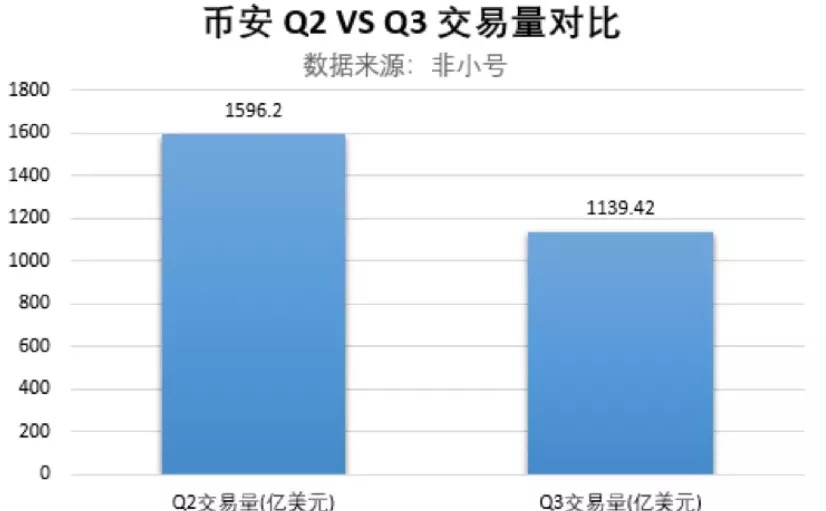
By now, it should be clear how Binance reported higher revenue in Q3 despite a major decline in trading volume.
The only plausible explanation is an artificial inflation of BNB buybacks and burns—a desperate and ultimately self-defeating tactic.
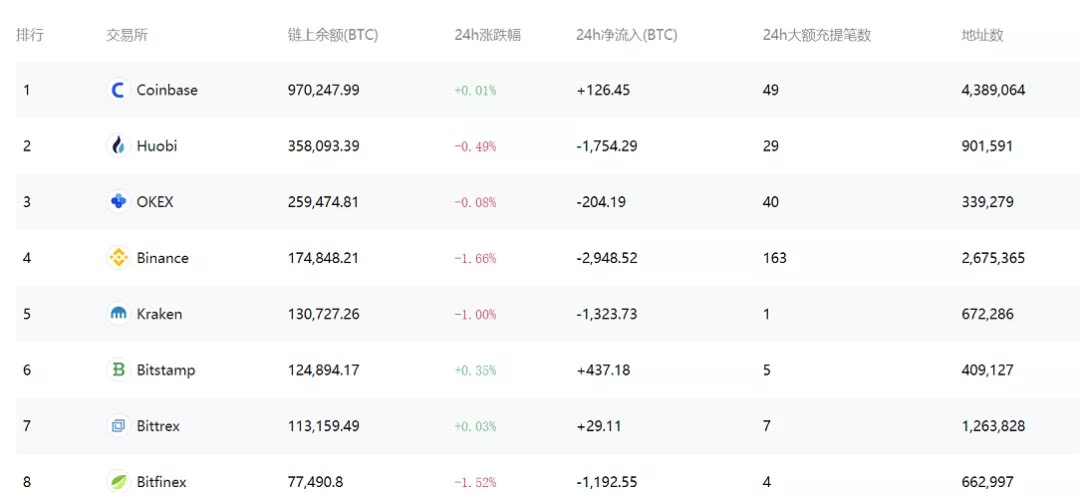
Further evidence that Binance's real revenue and trading volume are lower than reported comes from on-chain wallet balances. As of May 14, 2020, Binance's on-chain BTC holdings ranked fourth—84,630 BTC behind OKEx (third), 183,245 BTC behind Huobi (second), and a staggering 795,399 BTC behind leader Coinbase.
On-chain reserves are one of the most objective measures of an exchange's true strength. Clearly, neither steadily increasing BNB burns nor reported quarterly profits have reversed Binance's decline. From its peak as the industry's hottest newcomer in 2017, it has fallen from grace and now lags far behind the top three exchanges.
03
Opaque Finances: Both Revenue and Expenses
H1 2019 Investments Surpassed 2018's Full-Year Profits by 72%
Now, let's look at Binance's specific expenses in 2019. First, a quick recap of the platform's security history.
Since its 2017 launch, Binance's reputation has been repeatedly tarnished by security breaches, with hackers casting a long shadow over the platform.
March 2018: A large-scale phishing attack targeted user accounts in an attempt to steal funds.
May 2018: A major systemic attack resulted in hackers stealing 7,000 BTC from hot wallets.
July 2018: Another hack led to the theft of over 10,000 BTC.
July 2019: An attacker gained control of Binance DEX accounts, causing assets to vanish.
August 2019: Hackers stole KYC data from some users and leaked it in Telegram groups.
As a famous hacker once said, "Given enough time and attention, no platform is unhackable."
"It's not theft we fear—it's being watched." Judging by its track record, Binance has been a prime global target for hackers for years. Historical data indicates over 20,000 BTC stolen from the exchange—valued at more than RMB 800 million at various points.
For users, the fundamental requirement of any crypto exchange is asset security. Every outage or loss triggers panic. After the collapse of FCoin, trust in centralized exchanges grew even more fragile—frequent trading halts risk eroding user confidence entirely.
If Binance's 2019 revenue is opaque, its expenditures are even murkier.
First, the platform lost nearly 20,000 BTC to hacks in 2019—worth over RMB 800 million. That same year, Binance acquired India's WazirX and jointly established a $50 million (nearly RMB 350 million) Indian blockchain development fund. It also executed what the industry widely considers a money-losing acquisition: JEX, which reportedly remains unprofitable.
In 2020, Binance continued its aggressive expansion: acquiring CoinMarketCap (CMC) for $400 million (over RMB 2.8 billion) and investing in Tokocrypto, Indonesia's first licensed crypto asset exchange. Combined with other investments and unavoidable losses from 2019-2020, Binance's total spending in less than 18 months exceeded RMB 5 billion (nearly $700 million)—an unprecedented pace of commercial expansion.
Binance CEO Changpeng Zhao recently made a bold claim: the exchange allocates 25% of its annual profits to expansion and acquisitions.
However, Binance's own official data shows its 2019 profit was around $550 million. That same year, its "force majeure" expenses—including losses from hacks—plus investments totaled over $200 million. That's nearly 36% of its annual profit, well above the stated 25% allocation. Furthermore, by mid-2020, Binance's investments had already surpassed $400 million, representing 72% of its 2019 profit.
This raises questions. How did Changpeng Zhao foresee Binance's 2020 annual profit exceeding $1.6 billion? Or had the finance department already been instructed to artificially generate "impressive" BNB buyback figures for Q2, Q3, and Q4—crafting financial results more inflated and aesthetically pleasing than 2019's to obscure the unattractive balance sheet and financial risks stemming from rapid expansion?
04
The Financial Risks Left in the Wake of Rapid Expansion
A Robbing-Peter-to-Pay-Paul Strategy
Rapid expansion inevitably brings financial risks.
The crypto market currently faces two major challenges: cyclical adjustments and an overall decline in both user numbers and spot trading volume. With the 2017 bull market in retreat and no new bull run in sight, Binance seems to have hit a wall over the past two years. Its aggressive expansion appears to be a search for new opportunities and revenue streams. History shows that rapid expansion often leads to significant financial risks for companies. In crypto, these risks further morph into platform security risks, liquidity risks, investment risks, and operational risks.
Moreover, the financial risks faced by crypto exchanges are diverse and dynamic. Examples include: insufficient margin leading to liquidations, the inability to settle highly profitable leveraged positions during extreme market moves, and counterparty risk when hedging on other platforms—such as having one's connection abruptly severed ("pulling the plug").
Unfortunately, Binance has encountered all of these risks.
Recall the extreme market event of March 12, 2020: Bitcoin's price briefly plunged below $4,000. On perpetual futures markets, BitMEX spiked down to $3,596, while Binance hit $3,621.10. Concurrently, the BTC balance in Binance’s Risk Assurance Fund wallet showed abnormal fluctuations, dropping sharply at one point. That day, Binance recorded a net outflow of 7,933 BTC (13,549.53 BTC inflow vs. 21,482.54 BTC outflow), leaving its hot wallet with just 22 BTC—a rare event driven by massive simultaneous user withdrawals.
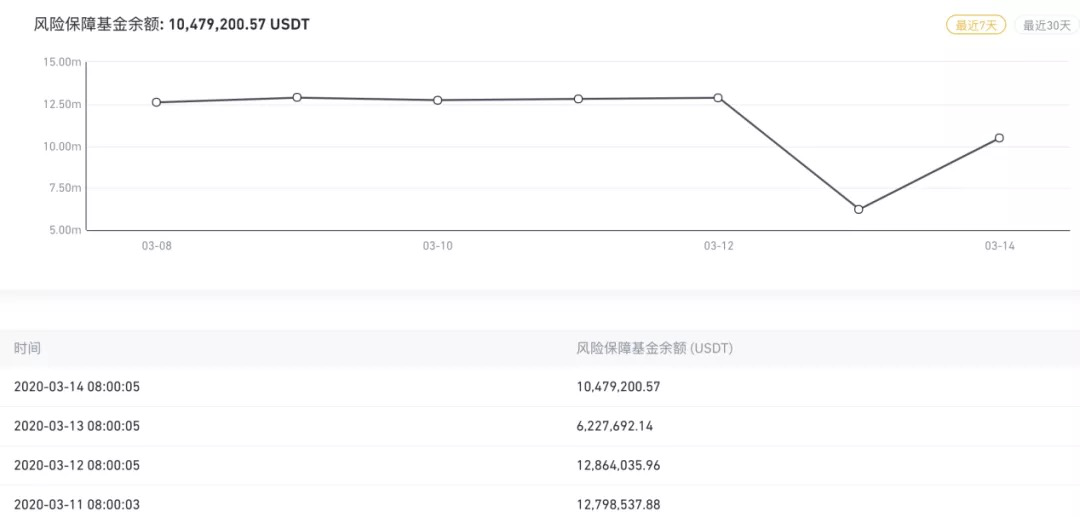
Screenshot of Binance’s Risk Assurance Fund
As is widely known, Binance's futures contracts use the ADL (Automatic Deleveraging) mechanism—often called the "profit-based deleveraging" system. This mechanism forces the liquidation of positions held by users on the opposite side of a trade. The liquidation order is determined by leverage ratio and profit percentage. When the Risk Reserve Fund is insufficient to cover losses from liquidations, the ADL mechanism kicks in. ADL rankings are calculated based on users' realized returns and effective leverage. Aggressive positions—those with high leverage and the highest profits—are prioritized for automatic deleveraging.
In simple terms: you can lose everything, but you can't profit too much.
Even with ADL in place, Binance's Risk Reserve Fund balance hit zero on March 12, amid widespread liquidations and an extreme imbalance between long and short positions. A situation reminiscent of the "Crude Oil Treasure" incident unfolded on Binance: long holders found no counterparties to take their positions, while short holders couldn't realize their massive profits upon closing. As a result, beyond automatically deleveraging some profitable short positions on the ADL ranking, Binance was forced to use its own capital to compensate short holders for their unrealized gains.
It's fair to say that on March 12 alone, Binance suffered a severe setback and incurred heavy losses.
05
The Story Behind USDT's Negative Premium
78.9% of Newly Issued USDT Ultimately Flowed to Binance
Since the crypto market crash on March 12, Tether—the issuer of USDT, often jokingly called the "Crypto Fed"—has engaged in massive, flood-like USDT issuance.
From March 12 to now, total newly issued USDT amounts to $4.249 billion (including authorized but not yet issued tokens). Starting in April and May, most new USDT was issued on the TRON blockchain; since May, all newly issued USDT has been minted exclusively on TRON.
According to Tokenview's data analysis, the majority of newly issued USDT ultimately flows into major exchanges like Huobi, Binance, and Bitfinex. Beijing ChainAn's tracking of ERC-20 USDT issuance flows in March and April showed that most newly issued ERC-20 USDT went to Binance and Huobi. For example, in April, 97.85% of newly issued ERC-20 USDT flowed into these two exchanges, with Binance accounting for 78.9%.
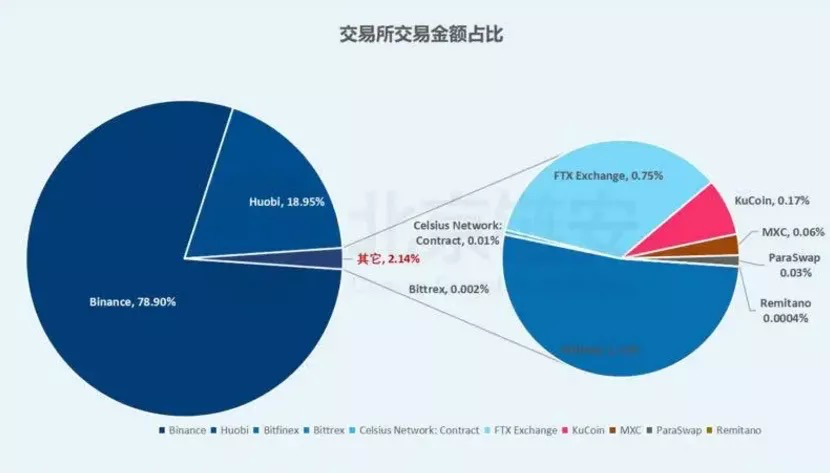
Binance's "money-printing" activity on TRON further suggests its investment scale has far exceeded expectations—creating significant cash flow pressure and financial risk, resulting in a large funding gap that necessitates printing even more money.
06
Does Binance really keep its hands off the crypto in your account?
This year, Binance was caught using users' digital assets to vote without their consent.
Here's what happened: STEEMIT witness nodes proposed a soft fork of the STEEM blockchain to freeze Justin Sun's tokens. Binance intervened by using assets held on its exchange to vote, successfully ousting other witnesses. Even more concerning, Binance then halted STEEMIT withdrawals. This casual use of customer funds is alarming.
Multiple signs point to a potential cash-flow crisis at Binance. These include massive token fundraising through Binance Earn, large-scale USDT minting on the TRON network, and repeated instances of misusing user assets. As time goes on, the full truth behind Binance's financial health will likely come to light.
Some in the industry believe that since the collapse of FCoin, many exchanges have started facing issues. This could be a "butterfly effect," with security problems seeded by FCoin now rippling across the sector.
There's even a market adage: "When Binance goes down for maintenance, BTC goes down." Binance's track record—including a hack resulting in over $100 million in BTC losses, launching high-risk P2P fundraising, aggressive expansion, misuse of user assets, and using its own capital to cover large profitable orders—paints a picture of a growing "gray rhino" risk. The potential impact of this risk on the crypto industry is still unknown.
In today's interconnected crypto market, if the "gray rhino" event linked to Binance were to occur, the blow to the industry could be as severe as the Mt. Gox incident, with potentially even wider repercussions.
Binance's actions demand serious vigilance and deep reflection from every investor and participant in the crypto space.