Author: Xiao Qifan, Researcher at HashKey Capital Research
Since 2021, the NFT market has exploded, with total market cap and trading volume skyrocketing. High-profile sales and celebrity involvement have thrust NFTs into the mainstream, drawing institutions, celebrities, IP holders, and everyday users into this burgeoning space. Competition within the NFT sector is still nascent, evolving from individual projects (like games or marketplaces) toward robust, user-friendly infrastructure. Notably, several major projects and IPs are now building their own dedicated blockchains for minting NFTs, signaling a maturing ecosystem. We believe Ethereum's network congestion and high gas fees significantly hinder NFTs from achieving mass adoption. Consequently, infrastructure solutions generally fall into three categories: (1) alternative Layer 1 blockchains that are NFT-friendly; (2) sidechains; and (3) Ethereum Layer 2 scaling solutions. In our assessment, high-quality public chains for NFT development include Flow and Near; prominent sidechains are Polygon, xDai, and Ronin; and leading Layer 2 solutions include Immutable X.
Infrastructure Challenges Exposed by the NFT Frenzy
Sustained Momentum and Mainstream Breakthrough
As of April 26, 2021, the total NFT market cap approached $26 billion, with Q1 trading volume exceeding $1.5 billion—a roughly 26-fold increase from the previous quarter. NBA Top Shot, CryptoPunks, and OpenSea collectively accounted for over 70% of Q1 volume. Meanwhile, average NFT sale prices climbed steadily throughout 2021. The chart below illustrates this trend: artist Beeple's NFT collage "Everydays: The First 5000 Days" sold for $69.35 million, while Twitter co-founder Jack Dorsey's first tweet NFT fetched $2.9 million. These record-breaking sales, amplified by celebrity influence, successfully brought NFTs into the mainstream spotlight. Below is a summary of key NFT events in 2021:
 NFT Price Trends, Source: The Block
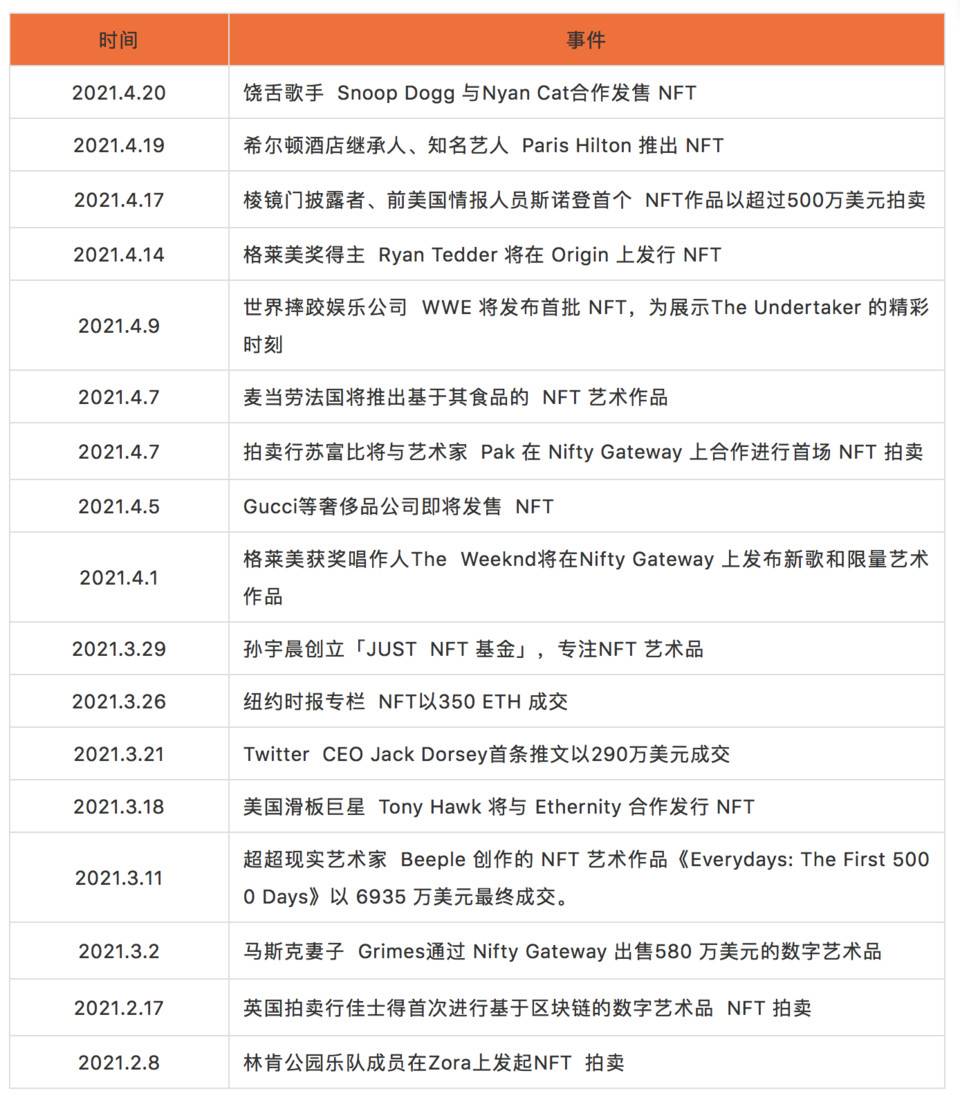 Representative NFT Events in 2021, Source: Public data
NFT Scalability Hampered by Ethereum's High Costs and Low Throughput
As of April 26, 2021, eight of the top ten highest-selling NFT projects were built on Ethereum, including CryptoPunks, Hashmasks, CryptoKitties, Sorare, Axie Infinity, Art Blocks, MyCryptoHeroes, and Gods Unchained. Concurrently, as the chart below shows, Ethereum's average transaction fee surged in early 2021, averaging $20 in February and $18 in March. Although fees dipped slightly in April, they remain prohibitive for high-frequency trading. Ethereum's performance limitations manifest in the NFT space in several key ways:
High minting costs: Minting an NFT is more complex and gas-intensive than a standard transaction. For instance, minting artwork on OpenSea cost around $200 in February or March and still about $100 in April—often exceeding the NFT's sale price.
High transaction fees and slow speeds: Most Ethereum-based NFT marketplaces require users to pay gas fees for both buying and selling (except Nifty Gateway, which accepts credit cards), and even delisting an item incurs a fee. Marketplace Mintable, for example, charges a 2.5% fee based on the bid price. Transfer confirmations are also slow, often taking 3–5 minutes.
Poor user experience: In gaming applications, character movement suffers severe lag compared to traditional web games. Some games even charge gas fees for each movement, degrading usability and hindering user retention and growth.
Exorbitant fees, network congestion, and a subpar user experience are Ethereum's core constraints—making it harder for NFTs, already a relatively high-barrier asset class, to achieve mass adoption. High fees alone deter casual users. Furthermore, Ethereum lacks native cross-chain interoperability. Therefore, finding scalable, high-throughput infrastructure solutions has become a critical strategic priority for the NFT industry.
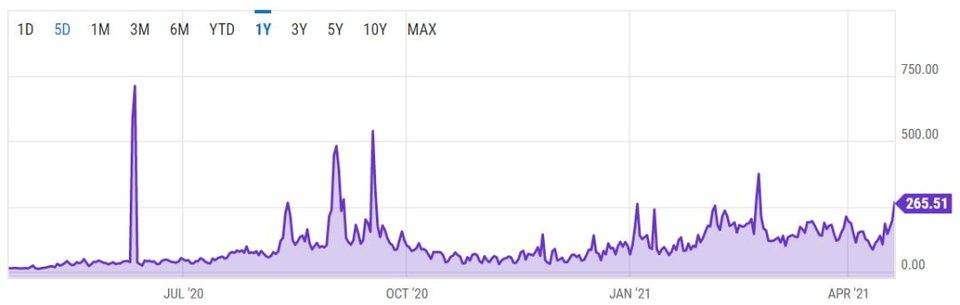 Historical Ethereum Gas Fees, Source: Ychart
Public Chains, Sidechains, and Layer 2: The Three Primary Alternatives
While Ethereum dominates DeFi, it holds no decisive advantage in Web3.0 domains like gaming, social media, and entertainment—key verticals for NFTs. This gap creates an opportunity for emerging public chains, sidechains, and Layer 2 solutions to capture market share. Overall, we don't expect a single, absolute winner to emerge across the entire NFT infrastructure landscape. Instead, solutions that combine competitive technical advantages with strong ecosystems will better align with market needs and have the best chance of becoming industry-leading platforms.
Public Chains
FLOW
Created by Dapper Labs, the Team Behind CryptoKitties
Flow is a new Layer 1 blockchain developed by Dapper Labs, the team behind CryptoKitties. Its CTO pioneered the ERC-721 token standard, now the foundation for most NFTs. Composed of game developers, Dapper Labs had built multiple developer platforms before entering blockchain. After CryptoKitties, the team doubled down on NFTs, tackling bottlenecks like throughput and fiat on/off-ramps, which led to Flow. Several team members have backgrounds in traditional venture capital and sports, providing rich resources and networks. Their philosophy—prioritizing usability and mass appeal—also fosters synergies between capital and traffic. Dapper Labs' latest valuation is $7.5 billion. Current Flow-based products include NBA Top Shot, UFC on Flow, NFT marketplace VIV3, browser Flowscan, and the collectible game Dr. Seuss.
A Low-Inflation Token with Diverse Utilities
FLOW is the native token of the Flow blockchain, used for paying gas fees, community governance, trading, staking, and more. The total supply is capped at 1.25 billion tokens to prevent inflationary dilution. As application usage grows and gas fees increase, FLOW's inflation rate declines. When network fees fall short of fixed node rewards, new tokens are minted; any excess rewards are held in escrow to hedge against future inflation.
Technical Advantage: Node Specialization Enables Scalability
Flow achieves scalability through node specialization via a pipeline architecture that separates computation from consensus. Individual nodes don't need to execute or validate full transactions; instead, each participates in one of four roles: Collection, Consensus, Execution, or Verification. All nodes must stake tokens, with rewards proportional to their stake under Flow's PoS consensus. The workflow is as follows: Collector nodes aggregate transaction data and submit it to Consensus nodes; once Consensus nodes confirm validity, Execution nodes perform computations; finally, Verification nodes validate the results. Nodes can choose roles that match their strengths—compute-heavy nodes can be Executors, while many low-compute nodes can specialize in Verification. For example, Samsung participates in Execution, DCG handles Collection, Consensus, and Verification, and CoinFund focuses on Consensus—details visible on Flowscan.org.
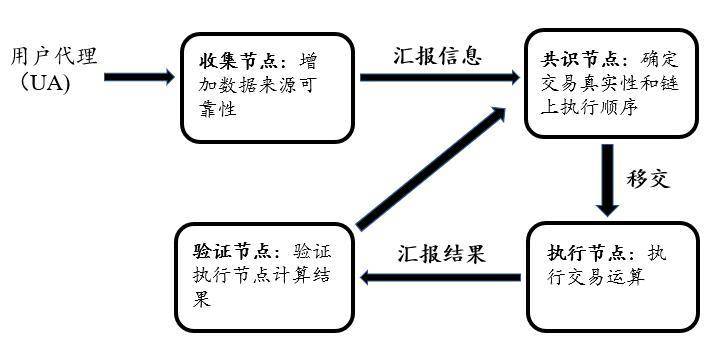 Flow Node Workflow, Source: Flowscan.org
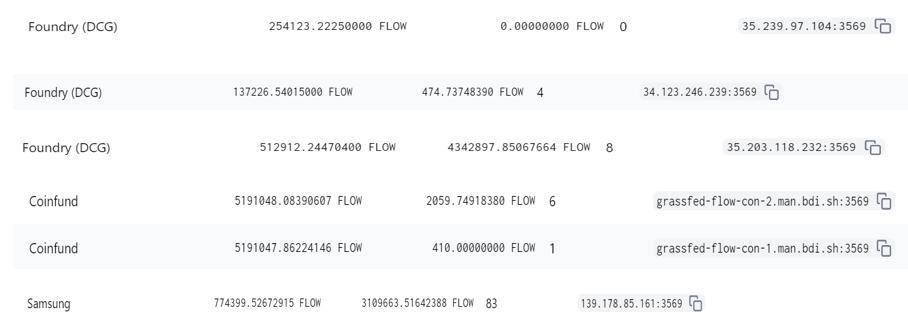 Flow Community Participants as Nodes, Source: Flowscan.org
Moreover, Flow scales without sharding the network—eliminating developer concerns about losing ACID guarantees in a fragmented environment. Smart contracts operate in a shared, unified state, enabling smoother cross-contract interactions. The reduced per-node workload means the network doesn't require highly specialized hardware to handle heavy loads, helping preserve decentralization. Flow's node-specialization architecture boosts transaction speed and throughput while lowering costs and improving the experience for both developers and end-users.
Market Advantage: Powerful IP Partnerships
Flow's rise as an NFT-focused public chain stems largely from its accumulation of premium ecosystem resources. Breakout hit NBA Top Shot has generated nearly $500 million in total sales, powered by the NBA's globally recognized IP. Beyond the NBA, Flow's partners include the UFC, NFL, Warner Music Group, leading game studios Animoca Brands and Ubisoft, Samsung, and NFT marketplace OpenSea. Top sports leagues like the NBA, UFC, and NFL command fan bases often exceeding 100 million and generate enormous revenue. LeBron James alone has nearly 50 million Twitter followers. These elite entertainment IPs give Flow a distinct advantage in potential user reach compared to other public chains. The diagram below illustrates Flow's ecosystem. Flow also plans to launch a council comprising IP holders, entertainment KOLs, and renowned game studios to track global trends—further enriching its access to entertainment intelligence and strengthening its foundation for building IP-driven collectible and fan economies.
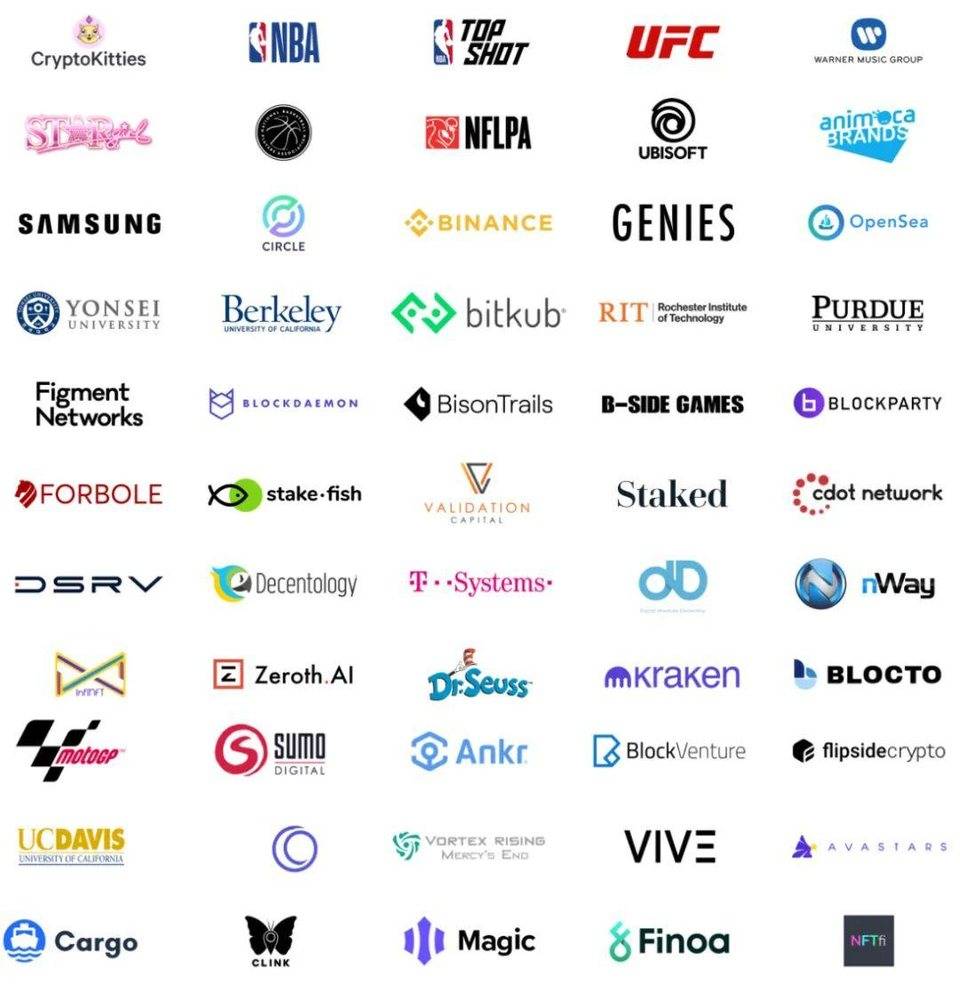 The Flow Ecosystem, Source: Flow
Backed by Top-Tier Investors
The chart below lists Flow's investors, which include prominent firms like a16z, Coinbase Ventures, DCG, and USV.
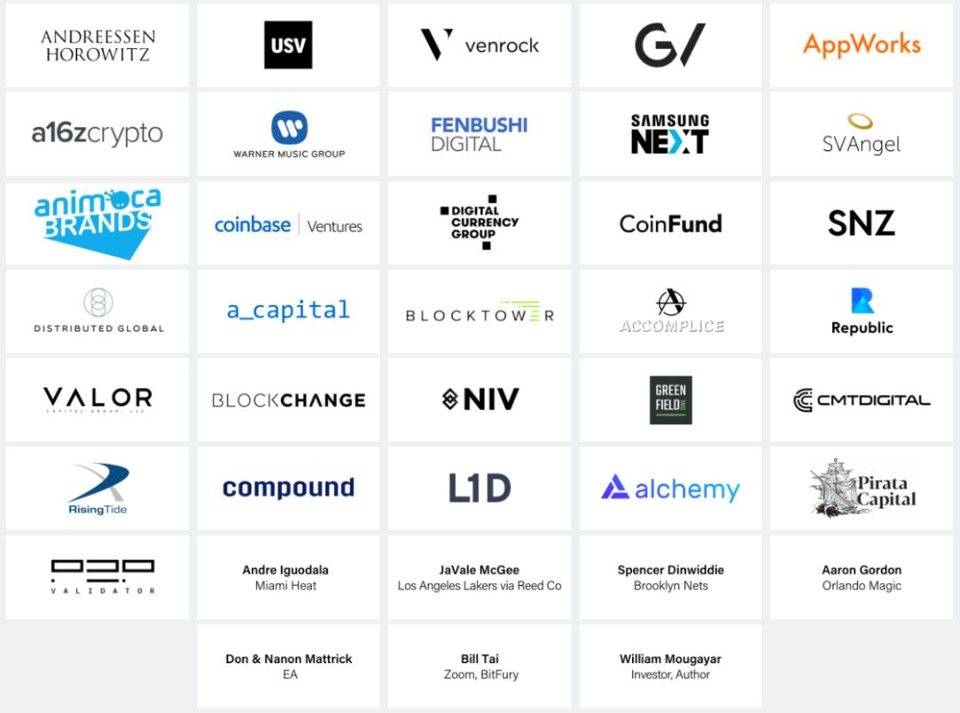 List of Institutions. Source: onflow.org
Near
An Emerging NFT Public Chain Powered by Sharding
Near Protocol is a decentralized network platform—a fully sharded, infinitely scalable new Doomslug blockchain. Its high-performance EVM processes transactions over 10 times faster than Ethereum. Using Nightshade's dynamic sharding method, the computational load for smart contract execution is relatively low, enabling transaction confirmation in just 1–2 seconds with an average gas fee under $1. The EVM has already launched on testnet and is expected to go live on mainnet within the next one to two months. The team currently comprises over 100 full-time contributors across ten countries. Near's investors include prominent institutions such as a16z, Coinbase Ventures, Metastable, and Accomplice, along with other angel investors.
Technical Advantages: Sharding Technology and the Rainbow Bridge
1. Nightshade Sharding Enables Effective Scaling
We believe Nightshade's sharding advantages are reflected in three key areas:
Shard Effectiveness: Near's approach to sharding differs from Ethereum 2.0, Polkadot, and Harmony. Instead of a model with separate shard chains and a beacon chain (where each shard must perform fork choice), Near focuses on a single main chain. Each block on this main chain is divided into multiple physical segments called "Chunks," meaning sharding occurs at the block level. Block producers and validators only need to maintain the correctness and state of the specific chunks they participate in. This results in shorter block intervals, stronger sharding effectiveness, and more complete data integrity.
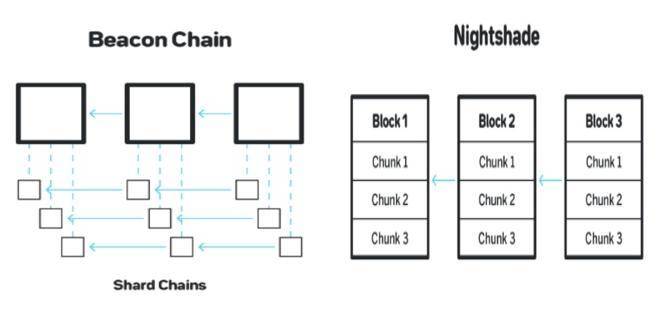 Comparison Between Shard Chain and Nightshade Sharding Models. Source: Near White Paper
Shard Security: Near randomly assigns validators using a Verifiable Random Function (VRF). Validator assignments to shards remain private—nodes do not know which validator corresponds to which block. During signing, validators sign the entire block rather than individual "Chunks," ensuring security at the shard level.
Data Reliability: Near ensures data reliability and inter-node communication by having each node split its generated block into distinct parts and distribute them among many validators. Validators only need a portion of the block to reconstruct the full block, achieving both data reliability and efficient cross-shard communication.
2. Seamless Integration With Ethereum via the Rainbow Bridge
The Rainbow Bridge operates through coordinated Ethereum and Near clients that can read and track each other’s chain states and execute corresponding actions—all in a trustless and permissionless manner. Once verified, assets can be transferred between chains via a relay layer. All ERC-20 tokens can move freely between Ethereum and Near, allowing the Near ecosystem to build seamlessly atop Ethereum’s mature infrastructure and leverage its established financial tooling. Users can directly send ERC-20 assets from MetaMask to a Near wallet or dApp—and vice versa—including NFT transfers. ETH can also be used to pay gas fees.
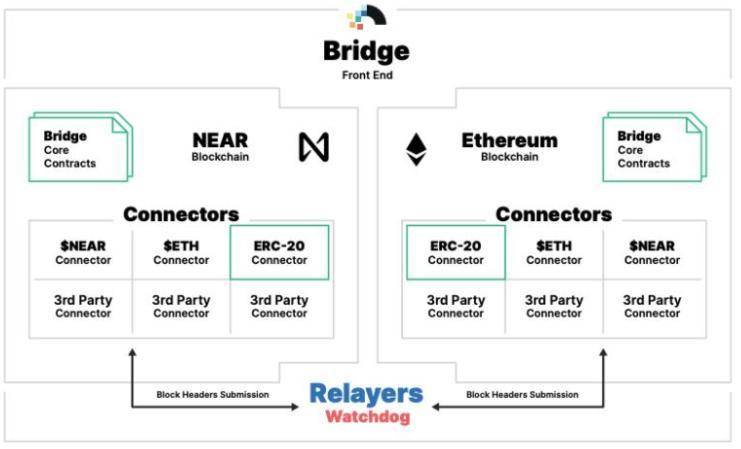 Schematic Diagram of the Rainbow Bridge Operation. Source: Near
NFT Ecosystem: Primarily Focused on NFT Marketplaces
Current NFT projects built on Near are listed below:
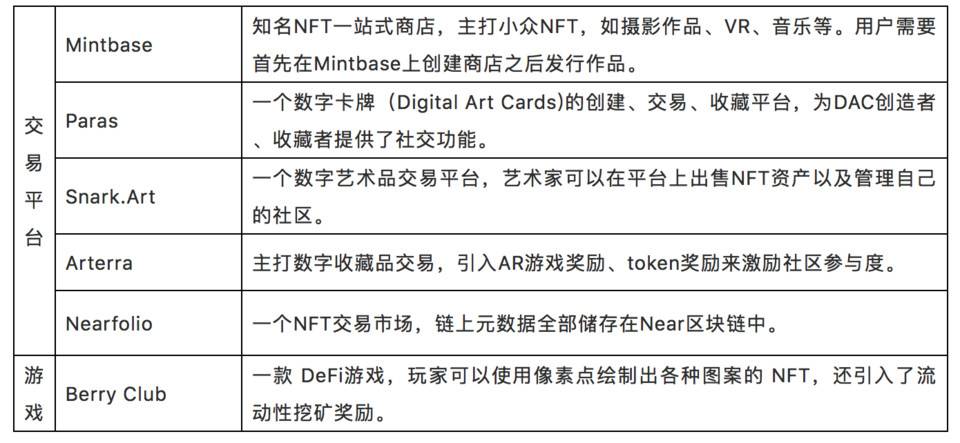
Currently, there are relatively few NFT projects on Near, and user bases—aside from Mintbase—are generally small. Most projects focus on NFT marketplaces. Near’s sharding technology is well-suited for the high-frequency trading and batch NFT tokenization needs typical of these platforms. Although Near’s current NFT ecosystem still lags behind Ethereum’s, its scalability advantages—combined with flagship projects like Mintbase—are expected to attract increasing numbers of NFT projects, positioning Near as another leading NFT-focused public chain.
Featured Project: Mintbase
Mintbase is an all-in-one NFT marketplace built on Near—think of it as the "Taobao" of NFTs. Its categories include music, artwork, collectibles, tickets, games, VR experiences, and more. Users can browse by shop, similar to other NFT marketplaces like OpenSea, but Mintbase emphasizes niche, differentiated NFTs. It currently hosts over 1,000 shops, more than 10,000 registered users, and has sold over 2,000 NFT pieces. Mintbase's biggest strength is its user-friendliness: artists, musicians, and everyday users—with no blockchain expertise—can tokenize their creations quickly and affordably. The barrier to entry for participating in NFTs is exceptionally low. On Ethereum, minting a single ticket via Mintbase costs $60–$100, making bulk ticket minting nearly impossible; similarly, setting up a store costs over $100. On Near, however, minting a ticket costs less than $0.01—effectively negligible. Mintbase chose Near for additional reasons, including tighter integration with other Near-native DeFi projects like Balancer.
Sidechains
Polygon (Matic)
A Particularly Thriving NFT Ecosystem
Polygon, formerly known as Matic Network, was founded by three members of India’s crypto community and rebranded in February 2021. Its native token is MATIC. Beyond its existing Plasma chain and Matic PoS chain, the rebranded Polygon plans to integrate popular scaling solutions including ZK Rollup and Optimistic Rollup. While its core mission remains scaling, Polygon now emphasizes building a diverse, multi-solution ecosystem rather than operating solely as a Plasma chain or sidechain.
Since its mainnet launch last June, Polygon has hosted over 130 applications, attracted 270,000 users, and processed 15 million transactions—most of which are NFT-related, especially gaming dApps. As shown in the chart below, Polygon’s daily active addresses and transaction volume surged significantly after March 2021: daily active addresses grew nearly 500% quarter-over-quarter, while transaction volume rose 288%, reaching $500 million in Q1 2021. However, most Polygon-based applications remain in early stages. Aside from top-tier dApps like DEX QuickSwap, DeFi+NFT game Aavegotchi, and horse-racing game ZED RUN, most others have fewer than 100 users. Leading DeFi and NFT projects—including lending protocol Aave, stablecoin swap protocol Curve, and NFT marketplace OpenSea—have all selected Polygon as their scaling solution.
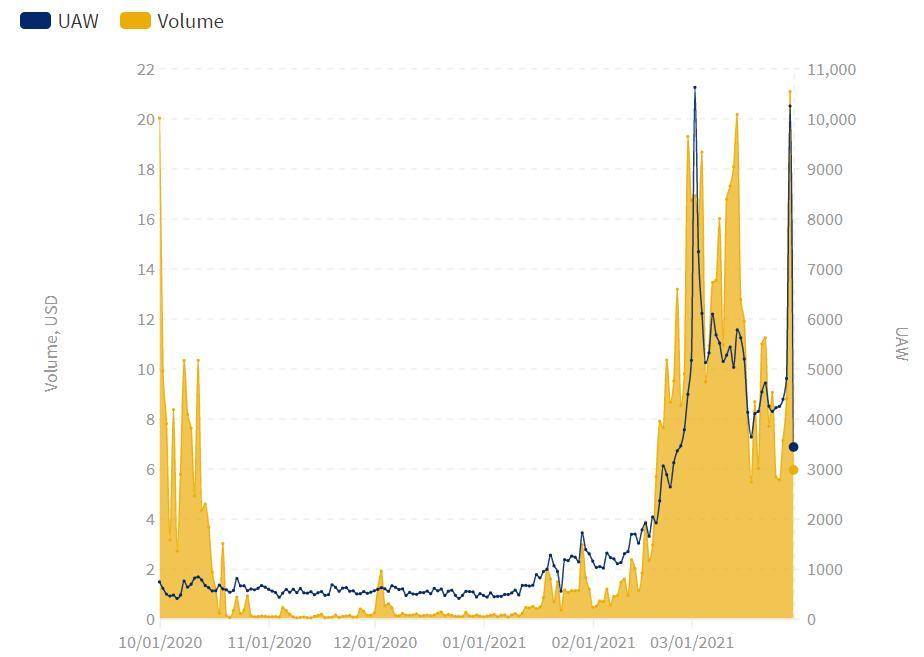 Polygon Transaction Volume and Daily Active Addresses in Q1 2021. Source: DappRadar
Technical Advantage—Diverse Scaling Solutions
Polygon continues to support Matic Network’s original scaling solutions: the Plasma chain and the PoS sidechain:
Matic Plasma Chain: The Matic Plasma Chain shares security with Ethereum. Fraud proofs or validating nodes provide protocol security. Within the Polygon ecosystem, different protocols can share validators. While Plasma ensures strong security, withdrawing assets from Plasma to Ethereum’s mainnet typically requires a 7–14 day lock-up period, limiting flexibility and independence. This makes Plasma less suitable for small-value, high-frequency transactions but ideal for security-critical applications such as high-value DeFi protocols.
Matic PoS Chain: Polygon’s PoS chain is a sidechain with its own security and consensus mechanisms, offering high independence and flexibility but also greater vulnerability to attacks and lower overall security. Such sidechains require numerous validators and suit projects with robust ecosystems and communities. For example, an NFT marketplace with a large, engaged community—prioritizing low cost and high speed over absolute security—would benefit from a PoS sidechain.
Overall, Polygon combines Plasma and PoS approaches: it achieves scaling via sidechains while maintaining shared security with Ethereum, enhancing efficiency without compromising safety. Additionally, Polygon plans to release an SDK enabling developers to simultaneously leverage multiple Layer 2 solutions—including Optimistic Rollup, ZK Rollup, and Validium—effectively launching a Layer 2 aggregator that implements hybrid scaling strategies.
NFT Ecosystem
1. Why Polygon Is Well-Suited for NFT Application Development
We identify three primary reasons why Polygon is well-suited for NFT development:
-
Polygon leverages its technological edge to deliver blazing-fast transaction speeds for gaming Dapps, averaging under 1 second per transaction. This creates a user experience nearly indistinguishable from traditional off-chain games. With transaction costs around $0.00004 each, Polygon effectively solves Ethereum's issues of high fees and slow speeds, making it an ideal platform for high-frequency NFT games. It's also EVM-compatible and supports MetaMask.
The simplified tool provider Biconomy, developed by a sponsor, uses meta-transactions to cover users' Gas Fees, significantly improving the user experience for decentralized applications.
For art collectibles, minting NFTs on Ethereum can be prohibitively expensive, often costing over $100 per mint. On Polygon, the cost is roughly 1% of that, dramatically lowering the barrier to entry for users exploring the NFT space.
2. A Gaming-Centric Dapp Ecosystem
The chart below shows Polygon's current NFT ecosystem, where about 70% of Dapps are gaming-related. Popular applications include Aavegotchi, a ghost-collecting game built within Aave's DeFi lending ecosystem; Decentral Games, a virtual world platform; ZED RUN, a digital horse-racing game; 0xUniversive, a space-themed game; Showcase, a digital collectibles platform; Tokenized Tweets, a tweet tokenization platform; F1 Delta Time, a racing game by Animoca Brands; OpenSea, the leading NFT marketplace; and Niftex, a fractionalized NFT platform. Polygon is widely seen as the preferred settlement layer for most Ethereum-based NFT projects migrating to Layer 2. It has also attracted notable figures: Jack Dorsey and Elon Musk sold NFT-tweet collectibles on Cent, a platform supported by Polygon, and Mark Cuban minted tweets via Tokenized Tweets.
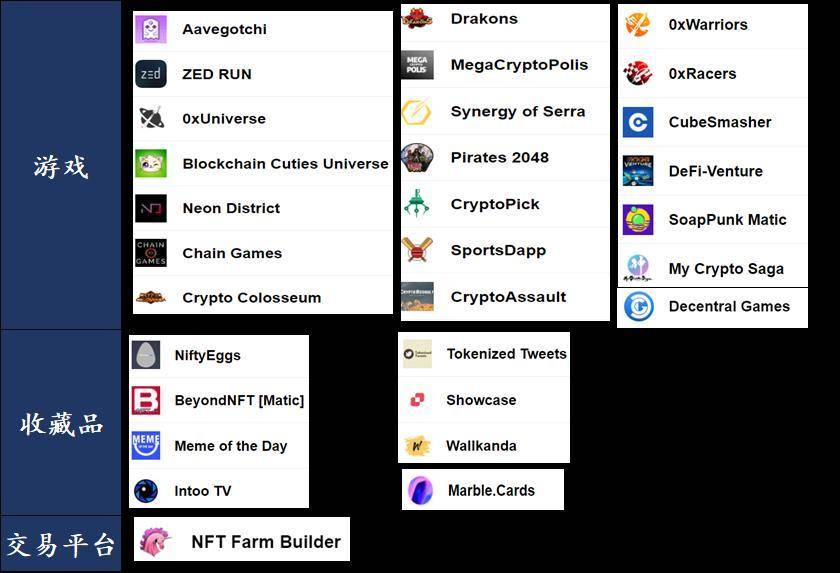 Source: Compiled from Dapp Radar
3. Featured Project: Aavegotchi
Aavegotchi is a DeFi+NFT project within the Aave ecosystem. Players stake aTokens to back Aavegotchi NFT ghosts, creating a collectible game with integrated DeFi functionality. As the chart below shows, Aavegotchi achieved over 3,000 daily active addresses after March 2021, cementing its status as a leading NFT gaming project. It was among the first Ethereum-based games to migrate to Layer 2. Its initial release of 10,000 Aavegotchi Portals sold out immediately. To encourage migration from Ethereum to Polygon, the Aavegotchi team launched a two-week yield farming campaign, rewarding users with GHST and MATIC tokens simply for migrating. Post-migration, Aavegotchi supports rapid cross-chain transfers of GHST between Ethereum and Polygon, allowing users to buy, sell, and trade in-game items on Polygon at minimal cost.
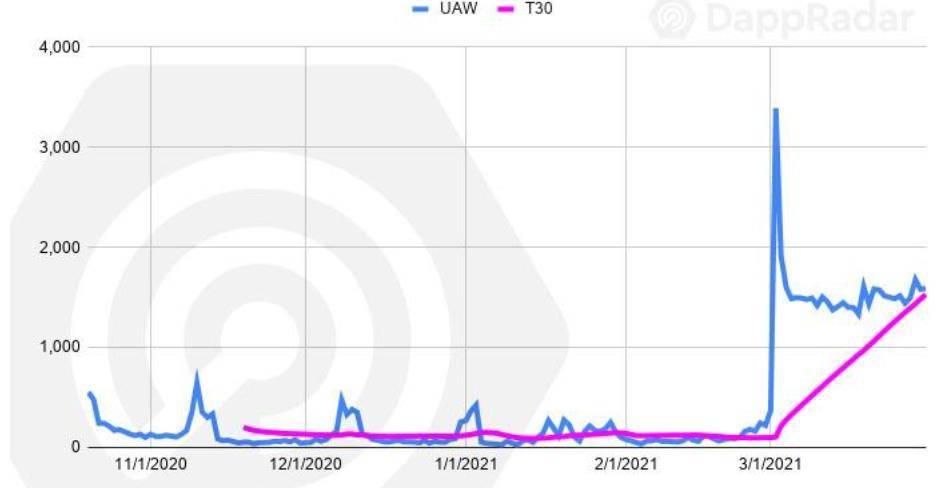 Aavegotchi Daily Active Wallet Addresses, Source: DappRadar
xDai Chain
A Sidechain Launched by MakerDAO
xDai Chain is an Ethereum sidechain launched jointly by MakerDAO and POA Network. Fully compatible with the Ethereum Virtual Machine (EVM), it shares identical EVM parameters with Ethereum and synchronizes protocol upgrades with the mainnet, enabling seamless, bidirectional asset and user migration. Key features include:
Cross-chain asset transfers between Ethereum and xDai Chain are enabled via the TokenBridge protocol. When assets are released, multi-signature signers must approve the transaction on the sidechain. TokenBridge uses a Proof-of-Authority (PoA) mechanism. While PoA grants significant authority—and potential for abuse—to private key holders, it greatly accelerates cross-chain transfers and improves the user experience.
The native xDai token is pegged 1:1 to the Ethereum stablecoin Dai, with both anchored to the U.S. dollar.
Dual-token governance model: Besides the xDai token used for transactions, the network features STAKE, a multi-purpose governance token. STAKE holders can participate in network performance upgrades.
xDai Chain uses its own consensus mechanism, POSDAO, while the cross-chain protocol TokenBridge uses PoA. Although PoA concentrates authority and risk with multi-signature key holders, it significantly boosts cross-chain efficiency. Blockchain explorers show that xDai Chain's validators include prominent entities like POA Network, 1Hive, and Gnosis.
Low fees and high speed: Current gas fees on xDai are about $0.0002 per transaction, with block confirmation times averaging around 5 seconds. A growing number of Dapps are migrating entirely to xDai, while others move specific functionalities—like voting modules—allowing community members to participate in governance at near-zero cost.
NFT Ecosystem—Heavy on Marketplaces
xDai Chain's low cost and high performance make it one of the most effective solutions for offloading Ethereum traffic. It currently hosts nearly 100 Dapps across infrastructure, P2P payments, DeFi, DAO governance, analytics tools, and NFTs. Representative projects include Dune Analytics, Unique One, DeBank, Honeyswap, Perpetual Protocol, and Dark Forest. NFT projects make up 20% (19 total), primarily marketplaces. The table below outlines xDai Chain's NFT ecosystem:
xDai's low cost and high performance significantly boost NFT adoption. For instance, minting on Nifty.Ink costs over $70 on Ethereum but is virtually free on xDai. Moreover, NFTs minted on xDai can be seamlessly and costlessly transferred to Ethereum via TokenBridge, allowing Nifty.Ink-minted NFTs to be traded directly on OpenSea.

Featured Project—Dark Forest
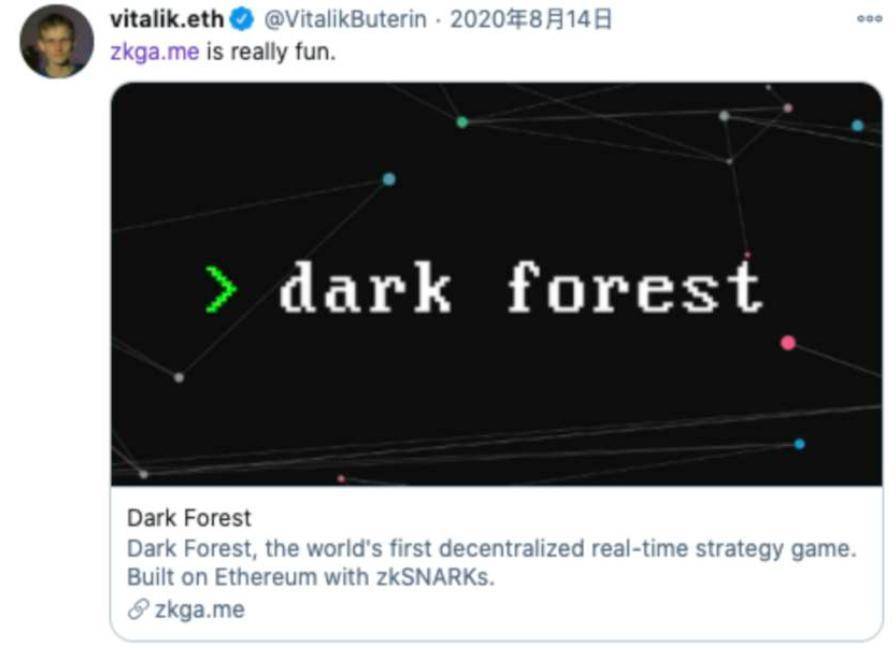
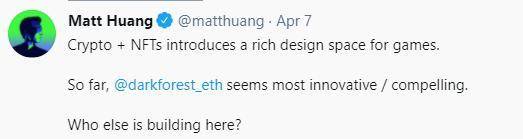
Named after the sci-fi novel "The Dark Forest" from Liu Cixin's "Three-Body Problem" trilogy, Dark Forest is a massively multiplayer online (MMO) space-themed strategy game. Players start with a randomly assigned home planet and expand their visibility and military strength by conquering others. What sets Dark Forest apart is its use of succinct zero-knowledge proofs (zk-SNARKs) to keep players' movement paths completely private, enabling fully confidential gameplay. Players cannot see other planets' military strength or distances, dramatically increasing strategic depth and engagement. Vitalik Buterin and Matt Huang, co-founder of Paradigm, have both publicly endorsed Dark Forest on Twitter.
In this game, each player movement incurs a gas fee. Players typically move multiple times per minute—a scenario impractical on Ethereum due to network congestion and high costs. xDai Chain removes these barriers, drastically reducing fees and enhancing gameplay.
Since its v3.0 launch in August 2020, Dark Forest has upgraded to v5.0, introducing a special Dark Forest NFT module obtainable through cosmic conquest. After migrating to xDai Chain with its v4.0 update in October 2020, Dark Forest reportedly accounted for 80% of xDai's total network transaction volume within days, demonstrating its explosive popularity. Users don't need to purchase crypto assets to play; the official team provides each new user with $0.05 worth of xDai to cover transaction fees. Additionally, top-15 ranked players receive Dai rewards as incentives.
Ronin
A Custom Sidechain for Axie Infinity
Ronin is a custom Ethereum sidechain developed by Sky Mavis, the team behind the popular blockchain game Axie Infinity, specifically for that game. Ronin uses a Proof-of-Authority (PoA) consensus mechanism, an enhanced variant of Proof-of-Stake (PoS). To ensure security and efficiency, PoA networks typically limit validators to 25 or fewer—less than typical PoS deployments. As a result, Ronin functions, to some extent, as a private blockchain dedicated to Sky Mavis and Axie Infinity.
All Ronin validators are trusted partners pre-approved by Sky Mavis. Its testnet launched on December 23, 2020, with Ubisoft, Animoca, and Nonfungible.com as inaugural validators. Current validators now also include analytics platform DappRadar and Binance. Validators are responsible for block creation and verification, as well as processing cross-chain asset transfers and custody between Ronin and Ethereum—including ERC-20 tokens and NFTs. The mainnet launched on February 1, 2021, starting with the migration of Axie Infinity's land plots and associated in-game items.
Advantages
We identify Ronin's key advantages as follows:
-
Blazing-fast transaction speeds—settlements are near-instantaneous.
Minimal transaction fees.
Axies can be moved freely between Ethereum and Ronin as needed.
A dramatically smoother user experience.
Built specifically for Axie Infinity, it better serves the complex, tailored needs of the Axie community.
The Ronin team is the same as the Axie Infinity development team, ensuring focused optimization of Ronin's performance.
While Ronin is still in its early stages and has yet to cultivate a mature NFT ecosystem beyond Axie Infinity, Sky Mavis’ CEO has stated that the team will continue to prioritize solving Ronin’s NFT scalability challenges. They are exploring more efficient approaches like zkSync, with the goal of establishing Ronin as one of the most effective scaling solutions for NFT gaming.
Axie Infinity
Axie Infinity is a blockchain-based, turn-based strategy game where players collect, breed, raise, and battle with NFT creatures called Axies—a concept similar to Pokémon. Its governance token is AXS. Players earn Smooth Love Potion (SLP) tokens by breeding Axies and can trade them on marketplaces like OpenSea.
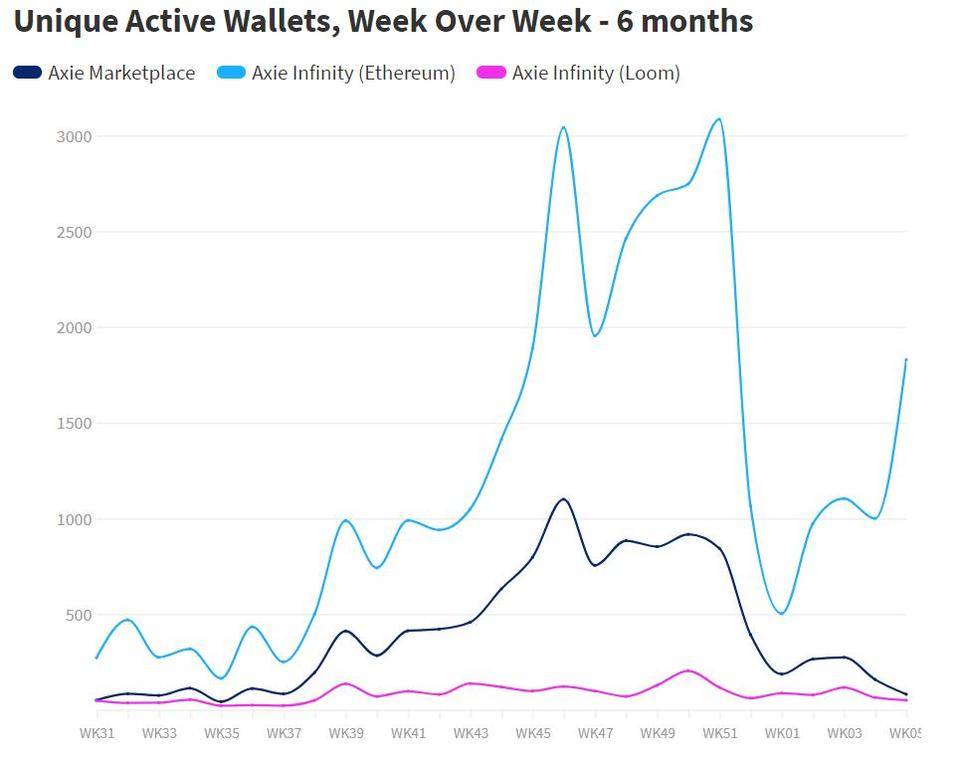
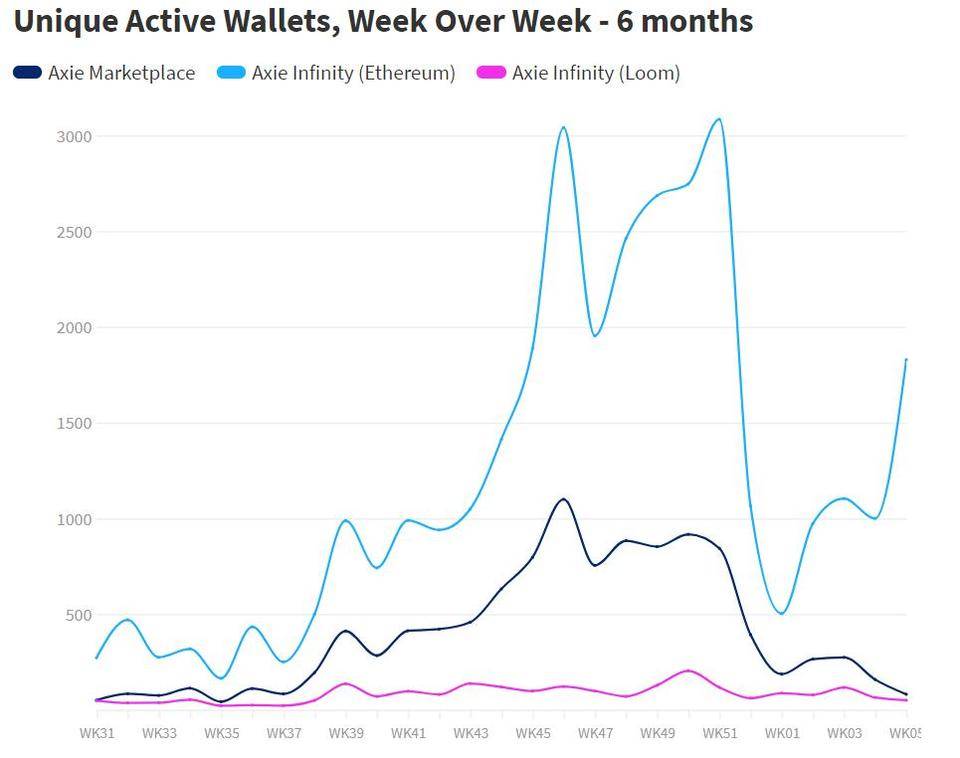
To date, Axie Infinity has generated nearly $20 million in trading volume. By late 2020, it had over 3,000 daily active users, ranking among the top blockchain games in both trading volume and popularity. However, entering 2021, severe congestion on the Ethereum network and soaring gas fees led to a user decline, with average daily active users dropping to just 523 in January. In response, the Axie Infinity team began planning Ronin and migrating assets.
 Source: DappRadar
Following Ronin's mainnet launch in February, Axie Infinity land plots and associated items were the first to migrate, managed by the Sky Mavis team. Users could also perform self-migration. Those who completed migration before March 1 were rewarded with new in-game land items. The team noted that Ronin is currently in Phase One of migration—supporting only ETH deposits/withdrawals and land/item transfers. Phase Two will introduce AXS staking on Ronin, full smart contract upgrades for Axie Infinity, and the complete migration of all Axie NFTs to Ronin.
Layer 2 Scaling Solutions
Immutable X
Developed by the Gods Unchained Team
Immutable X is a scaling solution launched by Immutable—the developer behind the popular blockchain card game Gods Unchained—in partnership with StarkWare, a zero-knowledge proof technology company. It aims to address Ethereum's NFT scalability issues. Based in Australia, Immutable secured $15 million in funding in 2019 from investors including Naspers, Galaxy Digital, and Apex Capital. Built on zero-knowledge proof technology, Immutable X achieves up to 9,000 TPS with negligible gas fees, making it an increasingly popular choice for NFT gaming projects.
Scaling Solution—ZK Rollup
Immutable X uses ZK Rollup, which bundles thousands of transactions into a single batch and employs SNARK-based zero-knowledge proofs. These proofs are verified by a Rollup contract on Ethereum's main chain, ensuring all transactions inherit Ethereum's security guarantees. ZK Rollup supports thousands of transactions per second, with potential for even greater throughput in the future. It also offers extremely low transaction fees and outperforms Optimistic Rollup and Plasma in speed, as it requires no fraud proofs or waiting periods. A key limitation of ZK Rollup is its functional simplicity (e.g., currently limited to transfers and swaps). StarkWare's ongoing development of CAIRO aims to enhance ZK Rollup's flexibility and general-purpose computation capabilities.
Key advantages of Immutable X's ZK-Rollup solution include:
High throughput and speed: Capable of over 200 million transactions per day and up to 9,000 TPS—compared to Ethereum's ~13–14 TPS. Enables near real-time trading.
Dramatically reduced gas fees: Minting or trading incurs virtually no gas cost.
No native token required; supports both ERC-721 and ERC-20 tokens.
NFT Ecosystem—Game-Centric
Major NFT projects currently integrating Immutable X as their L2 scaling solution include the card game Gods Unchained, NFT marketplace Mintable, DeFi+NFT project SuperfarmDAO, collectible card platform Epics.GG, monster-battling RPG Illuvium, game developer Lucid Sight (creator of MLB Champions Baseball and Crypto Space Commander), vehicular combat game War Riders, and virtual-world RPG Guild of Guardians. On April 1, OpenSea officially announced integration with Immutable X. Overall, most NFT projects adopting Immutable X are gaming-focused, with Gods Unchained being the most prominent and representative.
Flagship Project: Gods Unchained
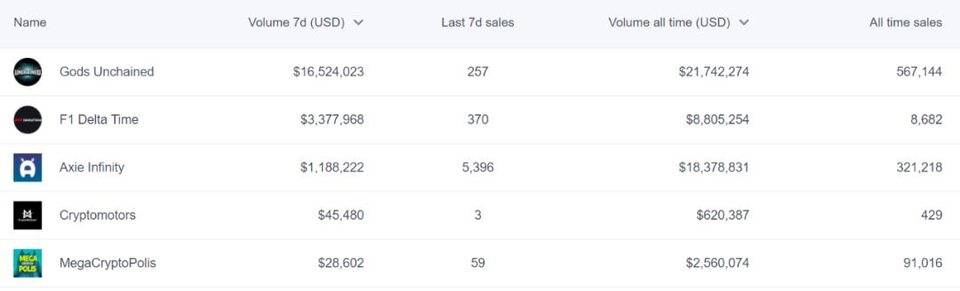
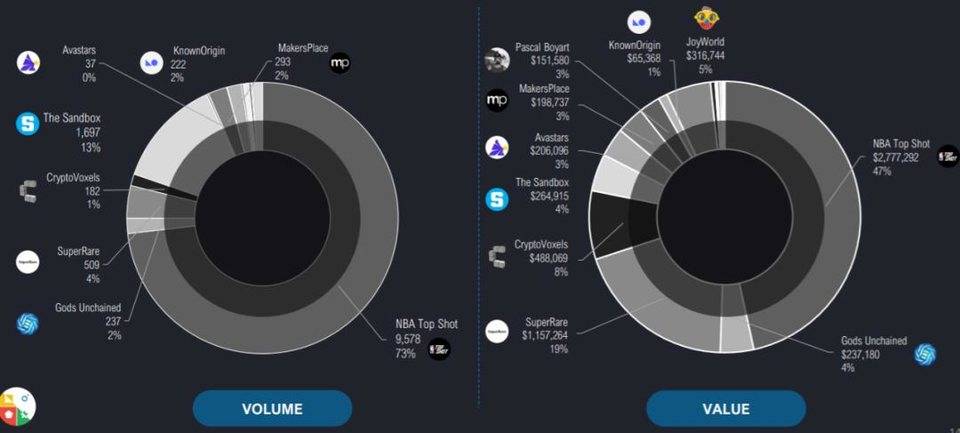
Gods Unchained is the world's first blockchain-based esports title, developed by Immutable. It's a fantasy-themed, turn-based competitive card game inspired by Hearthstone and The Elder Scrolls. Cards are tradable on OpenSea, with values varying based on rarity. Currently one of the hottest NFT games, Gods Unchained has accumulated $20 million in total trading volume and over 560,000 trades, according to nonfungible.com. Additionally, NonFungible's January 2021 audit report shows that Whale's treasury holds 237 Gods Unchained NFT cards—representing 2% of its total holdings and roughly $240,000 in value, or 4% of its treasury's total valuation.
 Source: nonfungible.com
On March 22, Gods Unchained officially announced integration with Immutable X as its Layer 2 solution—becoming the first dApp deployed on Immutable X. This allows users to connect their wallets and conduct low-cost, high-speed transactions. On April 9, Immutable X announced that Gods Unchained users saved over $410,000 in gas fees within the first 24 hours of the mainnet launch.
Value Assessment of the Three Scaling Approaches
Trade-offs Across All Options
We believe there is no one-size-fits-all infrastructure solution for NFTs. Public chains, sidechains, and Layer 2 protocols each involve distinct trade-offs. Projects must choose the approach that best aligns with their specific technical needs and strategic goals. Key characteristics and ideal use cases for each category in the NFT space are as follows:
Public Chains: Developers benefit from familiarity with existing tooling and avoid the complexity and asynchronicity of bridging to Ethereum. The downside is reliance on highly specialized nodes to handle base-layer workloads, which can compromise decentralization. While public chains impose few restrictions on NFT applications, ecosystem maturity and community activity remain critical evaluation criteria.
Sidechains: Enable rapid dApp deployment and low operational costs. However, they face security limitations—lower computational capacity and consensus stability compared to mainnets make them more vulnerable to attacks. They are best suited for applications involving frequent, low-value transactions where moderate security trade-offs are acceptable, such as NFT marketplaces and games.
Layer 2 Solutions: Offer tight integration with Ethereum's mainnet and leverage its robust financial infrastructure. Disadvantages vary across implementations (e.g., zk Rollup vs. Optimistic Rollup). They are ideal for mature Ethereum-based projects seeking to migrate only specific functionalities—such as voting mechanisms—rather than entire stacks.
Outlook and Bottlenecks
Leveraging Token Economics
Whether launching a new L1 chain, sidechain, or L2 protocol, issuing a native token serves vital functions—including governance, node incentives, and sustaining community and ecosystem health. This principle applies equally to DeFi and NFTs. Notably, community and ecosystem strength are especially crucial in the NFT space, making tokens powerful tools to drive participation—examples include FLOW, NEAR, and MATIC. Governance tokens issued by infrastructure projects also represent compelling investment opportunities.
Custom-Built Infrastructure Becomes Standard Practice
Following the lead of projects like Immutable X (powering Gods Unchained) and Ronin (built for Axie Infinity), we expect more prominent projects to develop their own custom NFT infrastructure. Looking ahead, this trend could expand beyond project teams to IP holders themselves, who may build dedicated infrastructure to launch NFT products and cultivate their own ecosystems. As these bespoke solutions mature, they will likely add new features and attract more applications, gradually evolving beyond their initial role as private chains.
Hybrid L1 + L2 Scaling Approaches Will Gain Traction
When it comes to scaling, balancing decentralization, security, and throughput remains a formidable challenge—often described as a "scalability trilemma." We don't believe the NFT infrastructure space will crown a single, perfect winner. Instead, hybrid approaches combining Layer 1 and Layer 2 solutions will become increasingly common. Polygon is a prime example, employing a multi-technology strategy that includes Plasma, Rollups, and PoS sidechains to meet the varied needs of developers.
Interoperability Between Scaling Solutions Is a Major Hurdle
As hybrid architectures grow in popularity, future Dapps may deploy different functions across various scaling solutions. This makes interoperability between these solutions a critical development area. Take OpenSea: it integrates multiple scaling solutions like Flow, Polygon, and Immutable X, using different ones for different functions. Ensuring a seamless user experience when a single Dapp operates across multiple scaling environments remains a key challenge.
How to Evaluate NFT Infrastructure: Tech, Ecosystem, Team, and Backers
Technological Edge
For any NFT infrastructure, a technological advantage is the foundation for survival and the most critical factor in early-stage evaluation. The primary question for NFT Dapps considering a migration is whether a solution can leverage its tech to solve throughput bottlenecks and improve user experience. Leading solutions like Flow, Near, and Polygon each have distinct technical strengths. Users can assess a network's technology by reviewing its whitepaper and media coverage.
Ecosystem Maturity
Beyond raw technology, the quality of an infrastructure's ecosystem is the most decisive factor for its long-term growth—Ethereum is the prime example. For NFT infrastructure, ecosystem quality hinges on two key dimensions: the quantity and quality of its Dapps, and its accumulation of IP resources.
Number and Quality of NFT Dapps: The number of Dapps is easy to gauge through platforms like DappRadar or a project's official site. Quality can be measured by active users, trading volume, community engagement, and third-party reviews. Evaluating both gives a clear picture of whether a network is a suitable home for a new NFT project.
Accumulation of IP Resources: Unlike DeFi, NFTs have a stronger connection to real-world interests, with greater demand for entertainment, social features, and market dynamics. High-quality IP can drive massive traffic, creating a synergy between user engagement and capital inflow to ensure a broad audience. This makes IP accumulation especially crucial for competitive public NFT blockchains, as demonstrated by Flow.
Team Background and Backing Institutions
When evaluating an NFT infrastructure team, look for a track record of successful, high-profile projects and deep familiarity with the NFT space—think Dapper Labs (CryptoKitties) or Immutable (Gods Unchained). The backing of major institutional investors like a16z, Coinbase Ventures, DCG, USV, Coin Fund, and Venrock also serves as a strong signal and a useful benchmark for users.