

On August 18, 2021, Visa purchased CryptoPunk #7610 for 49.5 ETH (approximately $150,000). The payment giant also released an NFT whitepaper, stating its intention to “engage fans in crypto and commerce.”

Source: Twitter
While this may be a minor move for Visa, it represents a major milestone for the NFT market.
01. Visa’s Entry Triggers Market FOMO
Visa’s purchase of an NFT first triggered users’ FOMO and frenzied buying behavior.
Within one hour after Visa announced its CryptoPunk purchase, approximately 90 NFTs from the series were sold. CryptoPunks’ daily sales volume surged 11-fold over the past 24 hours.
CryptoPunks’ floor price has risen to 75.5 ETH—equivalent to a minimum cost of $240,000 to acquire an NFT from this collection. Prices for other NFT projects by Larva Labs—the team behind CryptoPunks—have also surged.
According to data compiled by Zeneca_33, CryptoPunks and Meebits (Larva Labs’ 3D NFT project) saw their floor prices rise by 26% and 30%, respectively, over the past 24 hours. Another Larva Labs project, Autoglyphs, reached a floor price of 345 ETH on OpenSea.


NFT Project Floor Prices as of August 23 — Source: Zeneca_33
02. Visa Embraces a New Paradigm
Driven by CryptoPunks, NFTs have attracted broader attention. Yet it is important not to overlook that the NFT market had already entered a frenzied bull run prior to Visa’s entry.
In terms of quantity, according to incomplete statistics, there are nearly 200 collectible NFT projects alone. New projects emerge daily in this niche sector, each boasting distinctive, highly refined, and rich visual designs.
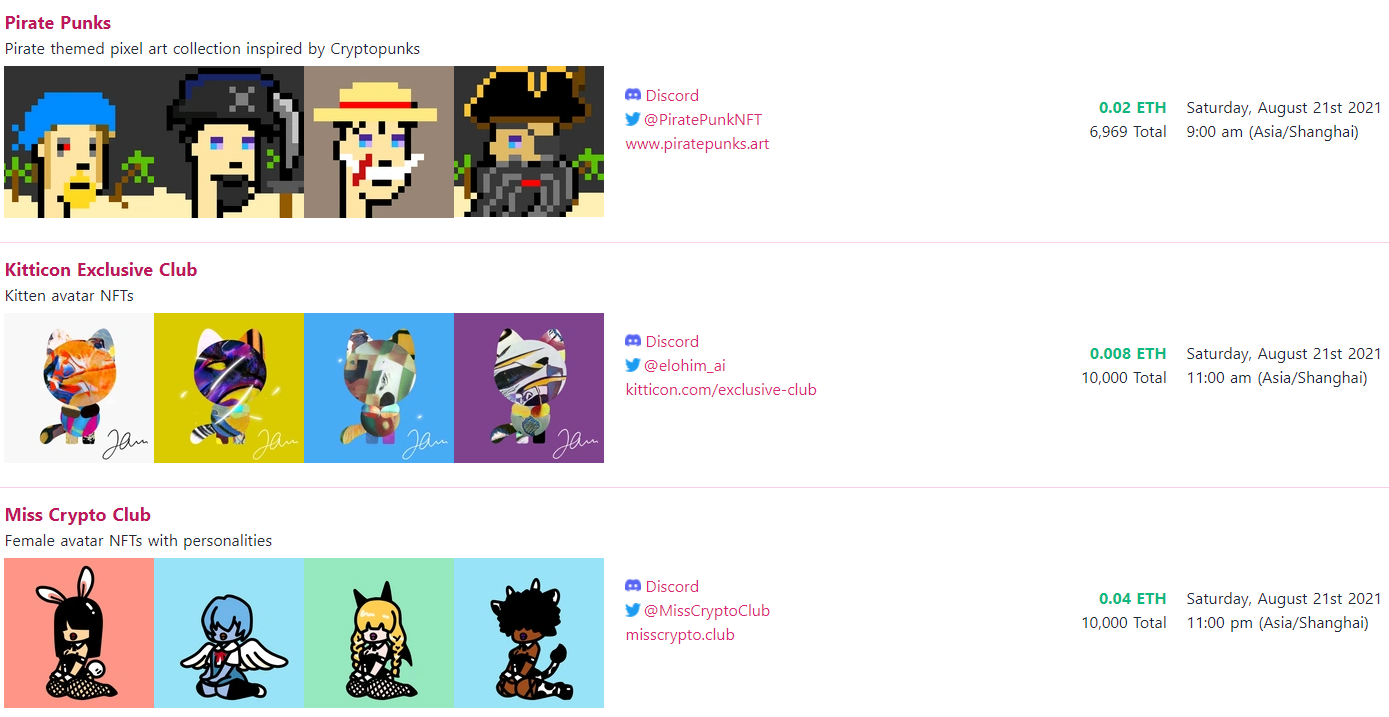
As shown on rarity.tools, at least four new NFT projects launched on August 21
Competition in this sector is fierce. Every day, breakout projects surpass established names like CryptoPunks, NBA Top Shot, and Bored Ape YC to claim top spots on NFT leaderboards.
In terms of trading volume, OpenSea—the leading NFT secondary marketplace—has consistently set new daily records. Following Visa’s announcement of its CryptoPunk purchase, OpenSea’s trading volumes reached $194 million on August 23 and $203 million on August 24.
Buyer sentiment remains extremely high. Numerous users on Weibo reported that their listed NFTs were snapped up within seconds of listing. The number of NFT users (across ERC-721 and ERC-1155 projects) has approached 1.5 million, while daily NFT transaction volume has consistently remained above 200,000.
NFT trading activity has even surpassed DeFi. Since Ethereum’s EIP-1559 went live, OpenSea—not Uniswap or other token-trading platforms—has contributed the largest share of gas fee burn.
In terms of pricing, sustained trading intensity continues to drive price appreciation. @rchen8 tracked the prices of the most recent 1,000 NFT transactions. The chart shows that the average secondary-market NFT price is currently in a rapid upward phase.
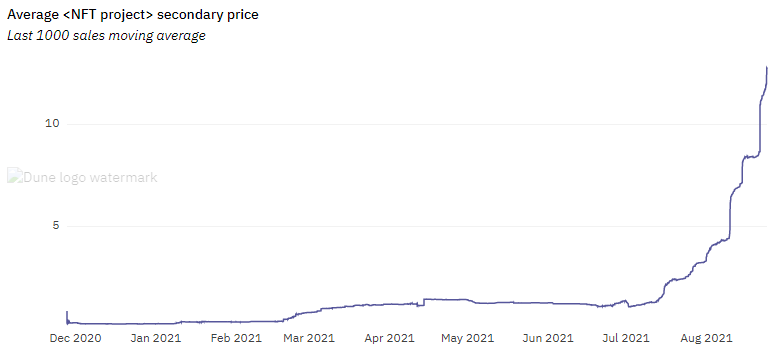
Average Price of Most Recent 1,000 NFT Transactions — Source: Dune Analytics
Some NFT sale prices are truly staggering. To date, the highest-priced NFTs are CryptoPunk #7804 and #3100—both sold for 4,200 ETH (over $7.67 million), now valued at more than $13 million each.

CryptoPunk #7804 and #3100 — each currently valued at over $13 million
Moreover, NFTs are gaining broader acceptance. According to an incomplete survey by Bibi News, prominent figures including Hayden Adams (founder of Uniswap), Stani Kulechov (founder of Aave), rapper Jay-Z, Hong Kong actor Louis Koo, and mainland Chinese actress Xu Jinglei have all adopted NFT avatars.
Traditional institutions are actively entering the NFT space. Beyond Visa, Tencent launched “Huanhe App,” China’s first NFT trading application; Alibaba introduced an NFT marketplace for copyright trading; Coca-Cola released NFT collectibles auctioned on OpenSea; Louis Vuitton launched a mobile game, The Game, featuring built-in NFT elements; and Twitter minted 140 NFTs and gifted them to 140 fans.
All this indicates that Visa’s entry into the NFT space has delivered tremendous excitement to the cryptocurrency market—yet more significantly, it reflects Visa’s proactive embrace of a new paradigm.
03. Significance of Visa’s Entry
In fact, Visa has been steadily and gradually expanding its footprint in the cryptocurrency space.
Visa has already made progress in supporting cryptocurrency payments. According to a report by 01 Blockchain, Visa has established partnerships with over 50 companies—including Coinbase, Circle, and FTX—enabling Visa users to seamlessly convert and spend cryptocurrencies at over 70 million merchants worldwide.
Visa’s adoption of cryptocurrencies has also driven business growth. Its Q3 financial report revealed that cryptocurrency-related spending contributed to a 34% year-on-year increase in overall Visa card transaction volume.
In the first half of this year, global consumers completed $1 billion in cryptocurrency payments using Visa cards. Regarding this, Visa stated: “We’re doing a lot of work to build an ecosystem that makes cryptocurrencies more usable—more like any other currency.”
However, like many other traditional institutions, Visa remains cautious about cryptocurrency’s high volatility, and its adoption is inevitably constrained by regulatory considerations. In essence, Visa’s stance reflects the prevailing position among traditional institutions.
Visa’s CFO, Vasant Pradhu, told CNBC: “Cryptocurrencies face many challenges, particularly around volatility. But managing and tracking these assets rests with cryptocurrency holders.”
Today, Visa’s purchase of an NFT avatar for nearly $150,000 carries significant meaning.
First, the current NFT market—characterized by fervor—mirrors the broader crypto market and may harbor bubbles and premium valuations. Visa’s decision to acquire a high-value NFT avatar under such conditions represents a bold experiment, signaling traditional institutions’ increasingly aggressive desire to participate in the industry.
Second, Visa commands access to a massive global user base, extensive partner networks, and vast customer resources. Its acquisition of an NFT serves as powerful publicity for the NFT space and could further accelerate NFT adoption.
Finally, as a model for traditional institutions embracing cryptocurrency, Visa’s NFT purchase may herald the beginning of institutional participation. Much like how MicroStrategy’s public Bitcoin purchases paved the way for Bitcoin to appear in the investment portfolios of publicly listed companies such as Tesla and Meitu, we anticipate the dawn of an era where institutions enter the NFT space.