

2020 is the year of the halving. As the event draws closer, anticipation for a "halving rally" continues to build.
Last week, the crypto community's excitement centered on the BCH and BSV halvings. "This is BCH's first halving since its creation—a truly historic moment," said a visibly excited Wu Jihan, founder of Bitmain.
According to Tokenview data, BCH reached block height 630,000 at 20:19 on April 8, completing its halving and reducing the block reward from 12.5 BCH to 6.25 BCH. Then, at 08:48 on April 10, BSV also hit block height 630,000, slashing its miner reward from 12.5 BSV to 6.25 BSV. With that, both assets have now undergone their respective halvings.
Despite the positive news, the market reaction has been underwhelming. CoinMarketCap data shows that in the 24 hours following BSV's halving, both BSV and BCH led the broader crypto market downturn, each falling over 10%. This sell-off pressure dragged BTC down roughly 5%, with other major cryptocurrencies also declining by more than 5%. According to Bybit Data, these moves triggered $157 million in long liquidations on April 10 alone.
"In these conditions, it's not just about mining profitability anymore—it's about whether miners can even cover their costs in fiat terms. If they can't, they'll be forced to shut down," lamented miner Zhang Xiaokang, who had bet on a post-halving surge, in a frustrated interview with Hexin Finance App.
In fact, many across the crypto space have placed similar bets on a halving-driven rally.
Dreams are grand, but reality is harsh. With BTC's own halving imminent, the disappointing performance of BCH and BSV—the cycle's early "vanguards"—now casts serious doubt on what lies ahead for Bitcoin.
A Disappointing Halving Debut
"2020 is a year full of opportunity and hope." A year ago, Zhang Xiaokang began preparing for the anticipated "halving rally."
In Satoshi Nakamoto's original design, the mining reward is cut in half every 210,000 blocks until BTC can no longer be subdivided.
To maintain an average block time of about 10 minutes, the network difficulty adjusts every 2,016 blocks, recalculated by all nodes using a standard algorithm. This system results in halvings approximately every four years, gradually approaching Bitcoin's hard cap of 21 million coins by around 2140.
To date, Bitcoin has undergone two halvings. The first was on November 28, 2012, reducing the block reward from 50 BTC to 25 BTC. The second occurred on July 10, 2016, cutting it from 25 BTC to 12.5 BTC.
In 2015, however, tensions rose over how to scale the network. Disagreements intensified between the small-block camp, represented by the Core development team, and miners and developers who opposed the Lightning Network and advocated for larger blocks. From the public emergence of the debate in May 2015 to the formal collapse of the New York Agreement in November 2017, the dispute lasted over two and a half years.
The direct result was Bitcoin's first major hard fork on August 1, 2017, which created Bitcoin Cash (BCH).
In April 2018, the BCH community released a mid-term roadmap with two main goals: (1) scaling—planning to increase the block size to 32 MB; and (2) adding or re-enabling several Bitcoin script opcodes to expand BCH's functionality.
Australian scientist Craig Wright (CW) strongly opposed this plan. He argued BCH should focus on capacity expansion and protocol stability, proposing to scale to 128 MB. To advance his vision, he launched the Nchain project and released the BSV node client on August 16, 2018.
Once again, irreconcilable differences led to a split. On November 16, 2018, BCH hard-forked into BCHABC (now commonly called BCH) and BCHSV (now commonly called BSV).
As forks of BTC, both BCH and BSV rank among the top ten cryptocurrencies by market cap, cementing their status as mainstream assets. They share a common origin and maintain a strong interconnection with Bitcoin.
BCH and BSV completed their halvings on April 8 and April 10, respectively—just about 30 days before Bitcoin's third halving. According to Bitcoinblockhalf.com estimates as of 06:00 on April 13, the BTC halving is projected for May 13. After that, the block reward will drop from 12.5 BTC to 6.25 BTC.

Countdown to the Bitcoin block reward halving. Source: Bitcoinblockhalf.com
The market reaction to the recent BCH and BSV halvings suggests the anticipated bullish catalyst failed to materialize. Instead, prices turned bearish, fueling broader market pessimism. CoinMarketCap data shows BCH did not see a significant post-halving surge, remaining relatively stable. Within 24 hours of the BSV halving, both BSV and BCH dragged down the wider crypto market, each falling over 10%. BTC dropped around 5%, with other major cryptocurrencies broadly declining more than 5%.
Yu Yang, COO of Kuanghai Mining Pool, told the "He Caijing" (Nuclear Finance) App that a halving alone doesn't guarantee higher prices—only increased demand can drive appreciation. Another crypto analyst suggested BTC may not see a sustained trend reversal and begin a true upward move until the end of this year, or even later.
Undoubtedly, the crypto market's fundamentals remain weak, with limited upward price momentum—making Zhang Xiaokang's concerns far from unfounded.
Hashrate Migrates to BTC
The staggered halving schedules of the three major cryptocurrencies have created a key battleground for miners looking to reallocate resources and maximize returns.
"The moment BCH completed its halving, its miners faced unchanged costs but saw their revenue cut in half," Zhang Xiaokang noted, explaining this dynamic has spurred hashrate migration.
The "He Caijing" (Nuclear Finance) App reached the same conclusion after consulting multiple industry veterans.
"The most direct impact of a halving is that miners' revenues are cut in half," said Liu Changyong, founder of Freedom Cash and an advocate of cryptographic economics. He stated that reduced output inevitably leads to a sharp drop in hashrate—a straightforward mathematical outcome.
He further explained that BTC, BCH, and BSV share the same mining algorithm. Their block rewards represent a shared income source for all SHA-256 miners, who naturally switch between these three chains to maximize profits.
Just as livestock follow pasture, miners follow profit. In Zhang Xiaokang's view, hashrate flows sequentially according to the halving schedule: first from BCH to BSV, then from BSV to BTC. After BTC's halving, the hashrate will shift again. Ultimately, miners continuously chase higher returns.
He stated this confidently, emphasizing that such hashrate movement is both traceable and observable.
As Zhang pointed out, following the successive halvings of BCH and BSV, both networks saw substantial declines in total hashrate. According to Tokenview data, at the time of BCH's halving on April 8, its network hashrate was approximately 3.69 EH/s with a mining difficulty of 523.62 G. At BSV's halving on April 10, its hashrate was about 2.99 EH/s with a difficulty of 429.52 G. By 20:00 on April 12, BCH's hashrate had fallen to roughly 2.51 EH/s with difficulty dropping to 243.01 G, while BSV's hashrate fell to about 1.49 EH/s with difficulty at 210.15 G. This confirms a marked decline for both chains, with BSV's hashrate effectively halved.
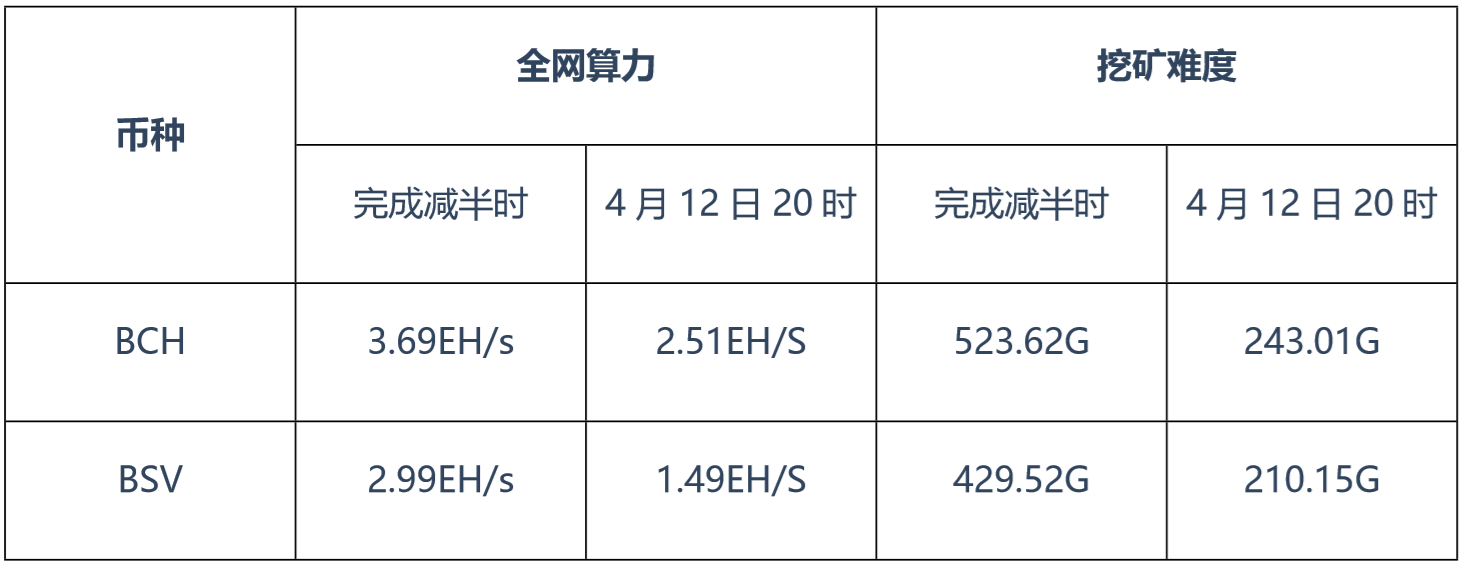
Hashrate and mining difficulty for BCH and BSV before and after their halvings. Source: Tokenview
Meanwhile, BTC's total network hashrate showed a clear upward trend. Since short-term theoretical hashrate doesn't always reflect actual figures, the mining community typically uses a 3–7 day average to estimate changes in global mining hardware. According to Tokenview, BTC's average network hashrate from April 5–7 was approximately 109 EH/s, rising to about 118 EH/s from April 10–12—an 8% increase.
Industry veterans believe that while short-term hashrate fluctuations aren't perfectly precise, it's clear that BCH and BSV recently experienced short-term outflows—and BTC absorbed that displaced hashrate.
However, with BTC's total network hashrate increasing, miner revenues are likely to face further downward pressure.
Notably, Liu Changyong also observed that price volatility itself can alter the direction of hashrate flow—the entire mining revenue landscape represents a dynamic equilibrium.
Following the sharp hashrate decline on the BCH and BSV networks, some industry insiders expressed concern that this could lower the cost of executing a 51% attack, thereby increasing network security risks.
Wu Jihan previously remarked that there's no need to over-worry about 51% attacks—even if one occurs, solutions will be found. His implication was clear: BCH is not afraid of 51% attacks.
Liu Changyong also pointed out a key difference in system stability. BCH and BSV adjust their mining difficulty with every block, allowing block times to normalize within a day. BTC, however, adjusts its difficulty only every 2016 blocks (roughly every two weeks). If hash rate plummets after the halving, the difficulty won't adjust immediately. "This could lead to slower block production for a while and potentially cause another round of network congestion," he explained.
The Elusive Halving Rally
This year has already seen a series of black swan events. The sharp crash on March 12-13 was particularly damaging, wiping out many long positions and leaving the market desperate for a strong rebound.
Against this backdrop, the entire crypto community has pinned its hopes on a post-halving rally.
"As the 'vanguards' of the halving cycle, BCH and BSV were seen as key indicators of upward momentum," said Zhang Xiaokang. Yet their recent price action has left investors stunned.
Singapore-based analyst Lindon Wang observed that around BCH's halving—in the two days before and after—relatively little new capital entered the market. Meanwhile, existing holders rushed for the exits en masse, resulting in weak buy-side pressure and a subsequent price drop. When BSV halved, the event turned bearish almost immediately, and the coin has struggled to recover since.
Consequently, many industry insiders are pessimistic about this BTC halving. Lindon Wang noted that the health of traditional financial markets now acts as a barometer for crypto. From this perspective, BTC's path to a major post-halving rally—or even a new bull market—is fraught with obstacles.
Historically, however, BTC halvings have been crucial catalysts for bull markets. Precisely because of this cyclical pattern, even amid the severe global financial damage from the pandemic, most crypto participants still hold high hopes for a halving rally. "The crypto industry has taken heavy losses this year," Zhang Xiaokang said. "Everyone is fully motivated, hoping to stage a spectacular comeback during the BTC halving rally."
Nonetheless, data suggests the wishful thinking that "halving equals an immediate price surge" may be misguided.
According to CoinMarketCap, during BTC's first halving on November 28, 2012, the price was around $12. It took nearly a year—until November 30, 2013—to reach the subsequent bull market peak of roughly $1,130. During the second halving on July 10, 2016, BTC traded at about $650. It then took nearly 530 days, until December 18, 2017, to hit the bull market top near $20,000.
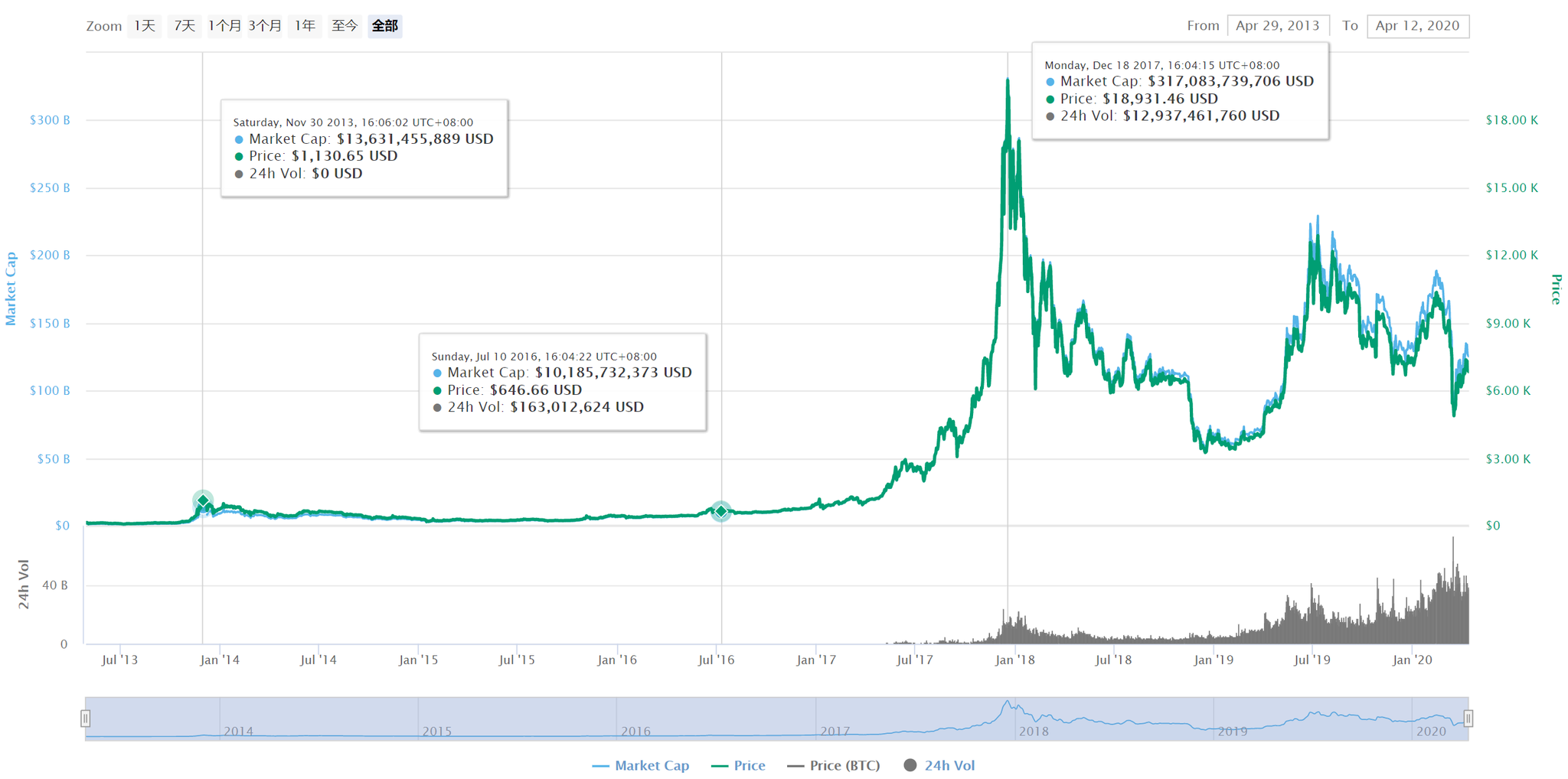
BTC Historical Price Chart. Data Source: CoinMarketCap
History often rhymes, but it never simply repeats. Liu Changyong believes the daily reduction in BTC issuance after the halving is negligible compared to the overall market size—ordinary market volatility can easily absorb it. The effect only becomes noticeable when the supply reduction accumulates over an extended period. "I've consistently said the impact of the BTC halving won't be felt until the second half of this year. Price movements around the halving event itself are normal and heavily influenced by market sentiment," he stated.
Jiang Zhuo'er, founder of Litecoin Pool (Litepool), also noted that the halving isn't a one-time bullish event but a sustained positive factor. He further believes the pandemic could act as a major tailwind for cryptocurrencies.
"Macroeconomic impacts cannot be ignored," Lindon Wang remarked. "Given the unprecedented crisis unfolding in global financial markets, the BTC halving carries significantly heightened uncertainty." He expressed pessimism about BTC's price outlook this year, with some even arguing that the halving rally may have already been priced in prematurely.
In this climate of uncertainty and transition, the crypto community remains hungry—and everyone is watching closely.