
Original Title: “How to Make Micropayments Using the Bitcoin Lightning Network?”
Original Author: Jonas Gross, Chair of the Digital Euro Association (DEA)
Translated and Compiled by: Baize Research Institute
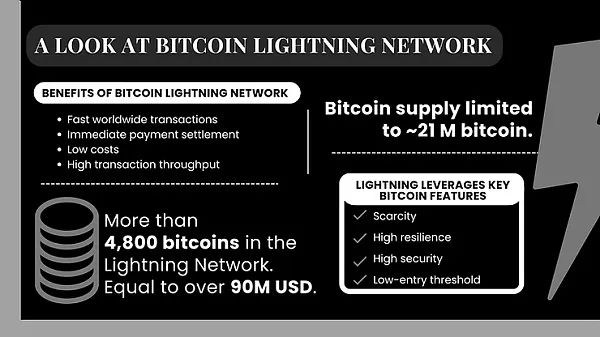
The Bitcoin Lightning Network is gaining significant traction. Adoption is accelerating, with the network now holding over 4,800 BTC—valued at more than $90 million. Institutional interest is also on the rise. For instance, Lightning Labs, the main contributor to the Lightning protocol, secured $70 million in a Series B funding round earlier this year. The number of companies offering Lightning Network services is growing rapidly as well.
This article explains why the Lightning Network is needed and how to use it.
Bitcoin as a Global Payment System?
Bitcoin has clear advantages as a decentralized payment system, allowing for cross-border transfers without intermediaries.
Perhaps most importantly, Bitcoin is incredibly accessible. Anyone with an internet connection can use it, and no one can be excluded—a powerful driver for financial inclusion. It also functions as a scarce digital asset, often called "digital gold." Each Bitcoin is divisible into 100 million satoshis, similar to how a dollar breaks into 100 cents. Unlike fiat currencies, Bitcoin has a fixed supply capped at 21 million coins, making it immune to devaluation through inflation.
However, the Bitcoin network's current design has trade-offs. Its decentralization comes at the expense of transaction throughput, which is limited to roughly seven transactions per second.
This low throughput is inadequate for a global payment system. Established providers like Visa or Mastercard can process thousands of transactions per second, offering far greater scalability—albeit through centralized systems. Bitcoin transactions also typically require longer confirmation times, making the network less practical for everyday, small-scale payments.
Bitcoin also faces limitations for micropayments. Transaction fees are based on data size, meaning larger transactions cost more. While fees average around $1 today, they can spike dramatically during network congestion—reaching over $60 at the peak in 2017. For large transfers, these fees may be acceptable, but they render small, everyday payments impractical.
The Lightning Network Offers a Solution
Enter the Lightning Network. Designed to make Bitcoin viable for daily transactions, this layer-2 solution aims to boost throughput without sacrificing decentralization—a key requirement for any payment network. In practice, it enables faster, cheaper, and more frequent payments. While Bitcoin's whitepaper emerged in 2008, the Lightning Network concept was proposed in 2015, with development starting the following year. Early adoption began in 2018, and the technology has evolved quickly since. Despite growing transaction volume and recent strides, as of 2022, it was still considered an emerging technology.
How does the Lightning Network tackle Bitcoin's low transaction throughput and high fees? The key is that not every transaction is recorded on the blockchain (i.e., "on-chain"). Most payments happen "off-chain" between participants and are only settled on the blockchain in exceptional circumstances or when a payment channel closes. This allows for instant, low-cost payments. Users sending funds via the Lightning Network don't wait for Bitcoin network confirmations—their transactions are processed immediately.

How the Lightning Network Works
Let's look at a real-world example to understand how the Lightning Network operates.
Imagine you're out for a night with friends. You want to buy everyone a round, but paying for each drink separately is a hassle. Instead, you hand your card to the bartender, who keeps a running tab. At the end of the night, they tally everything up and present you with a single bill.
This "tab" works much like the Lightning Network. When you send a transaction request via a Lightning channel (off-chain), the recipient opens a "payment channel" with you—similar to the bartender keeping your tab. In theory, the two parties can exchange an unlimited number of these "tabs." The final settlement happens on the Bitcoin network (on-chain).
How to Use the Bitcoin Lightning Network?
1. Set Up a Wallet
First, download and set up a Lightning wallet on your smartphone or computer. The process is straightforward—much like setting up a self-custodial Bitcoin wallet—and ensures you retain full control of your private keys.
You have plenty of options today, including wallets like Zeus, BlueWallet, Phoenix, and Breeze. We'll use Phoenix as our example.
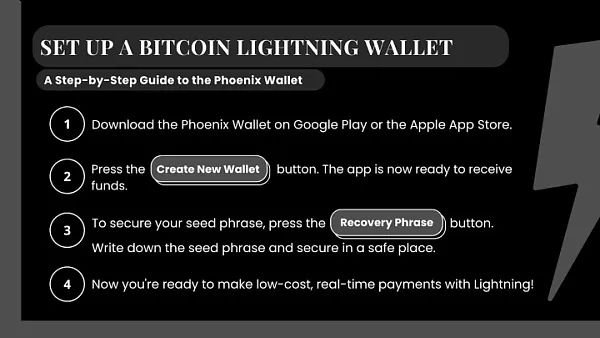
Once you've downloaded Phoenix Wallet from the app store, tap "Create New Wallet."
Your wallet is now ready to receive funds. To get your address, simply tap "Receive."
Please note: Your first incoming payment must be at least 10,000 satoshis (0.0001 BTC).
As a self-custodial wallet, Phoenix Wallet puts you in full control of your assets. This means you are solely responsible for securing your recovery phrase. To view it, tap the "Recovery Phrase" button within the app. Write down the phrase and store it in a safe place—you'll need it to restore your private and public keys if necessary.
2. Fund Your Wallet
Next, you'll need to fund your Lightning wallet. This involves sending BTC from your self-custody Bitcoin wallet or an account with a custodial service like Coinbase or Binance to your Lightning Network wallet. Simply enter your Lightning Network receiving address and authorize the transaction with your private key.
For security, you should wait for the transaction to receive multiple confirmations on the Bitcoin blockchain—typically six, which takes about an hour—to ensure the deposit is fully settled.
3. Open a Payment Channel
Next, you'll need to open a payment channel with the person or business you want to transact with. For instance, if you're paying for coffee via the Lightning Network, you would open a channel directly with that café.
When you open a channel, you lock funds into it. This balance is then available for instant, low-fee payments between you and your channel partner.
4. Make a Payment
Once funds are deposited, users can transact directly within the payment channel. For instance, a café can generate a Lightning Network invoice (usually as a QR code). You simply scan it with a compatible wallet—like the Phoenix wallet mentioned earlier—and confirm the payment.
Summary
Setting up a Lightning Network wallet takes just minutes. The initial deposit into your wallet and the funding of payment channels each typically take about an hour. Once you have BTC in both your wallet and the channels, you can make instant, real-time payments over the Lightning Network. This unlocks the network's core benefits: fast transactions with minimal fees. It's a game-changer for small-value payments, like buying a cup of coffee.
In practice, you don't need to open a payment channel with every coffee shop you frequent. Lightning wallets typically don't create new channels for each transaction; instead, they route payments through existing, available channels. This routing depends on channel capacity and liquidity distribution. To ensure high payment success rates and network reliability, participants should avoid minimizing routing fees. A "selfish routing strategy" can deplete channel capacity and ultimately reduce the overall number of payments the Lightning Network can process.