
A sense of gloom has settled over the market since the Bitcoin halving, particularly among investors, marked by a noticeable drop in discussion and attention around crypto.
This mood likely stems from a fundamental misunderstanding of how the halving affects prices. After months of hype, many expected an immediate post-halving surge. The fact that a significant rally hasn't materialized as hoped has naturally led to disappointment, especially for those who stayed in the market specifically betting on that outcome.
Beyond the current letdown, there's growing anxiety about what comes next. Before the halving, the entire narrative was focused on the event itself. Now that it's passed without major fireworks, the community is left wondering what the next big story will be, with no clear successor in sight.
This leads to a bigger question on many minds: even if new positive catalysts emerge, can any match the sheer magnitude of the halving?
These feelings are understandable. Price action has been muted, and no obvious short-term catalysts have appeared. However, we must assess the situation with absolute rationality, avoiding the temptation to let surface-level sentiment obscure the underlying reality.
First, on post-halving price appreciation: it's far too early to call it a failure. As we noted before the event, a "rally before, correction after" pattern is historically common. The market hasn't even corrected significantly and may still be trending up, which is a relatively optimistic scenario.
Furthermore, historical data shows that halving-related price movements rarely happen at the exact moment of the event; they typically play out over the following months. Therefore, it's reasonable to maintain expectations for market performance in the coming months and into 2021.
Second, while no major catalysts are obvious for the second half of the year, that doesn't rule out the emergence of new trends. Think back to the 2017 ICO boom or the 2019 IEO wave—few predicted their profound impact before they took off. Notably, Ethereum-based ICOs were a primary driver of the 2017 bull market.
Ethereum's potential remains significant, evidenced by the surge in projects building on it this year. Events like Filecoin's Phase 2 launch today (May 15th) continue to draw intense investor interest. So, concerns about a lack of relevant topics in crypto are premature.
Finally, we must look beyond the prevailing sentiment. In a pessimistic environment, independent thinking is difficult, and herd mentality takes over. But remember: consensus doesn't define reality. Crypto markets are structurally set up so that a minority profits while the majority loses. If the majority sentiment were reliably correct, most participants would be profitable—history consistently proves otherwise.
As Cointelegraph reported on May 14th, following the halving, investors moved 23,540 BTC (worth over $200 million) from exchanges to private wallets, suggesting renewed confidence in Bitcoin's long-term value. The choice is clear: trust verifiable on-chain data or the casual chatter of the crowd. We trust our readers to decide.
In summary, things aren't as bleak as they seem. Walking away now out of disappointment or boredom risks missing the next major turning point and joining the party too late. Even if we tell ourselves "I'll just ignore it for now," experience shows we often come rushing back once momentum returns. Why not stay engaged from the start?
Turning to the charts: the market has rebounded sharply from its recent correction without consolidating at the lows, forming a textbook V-shaped recovery on the daily chart.
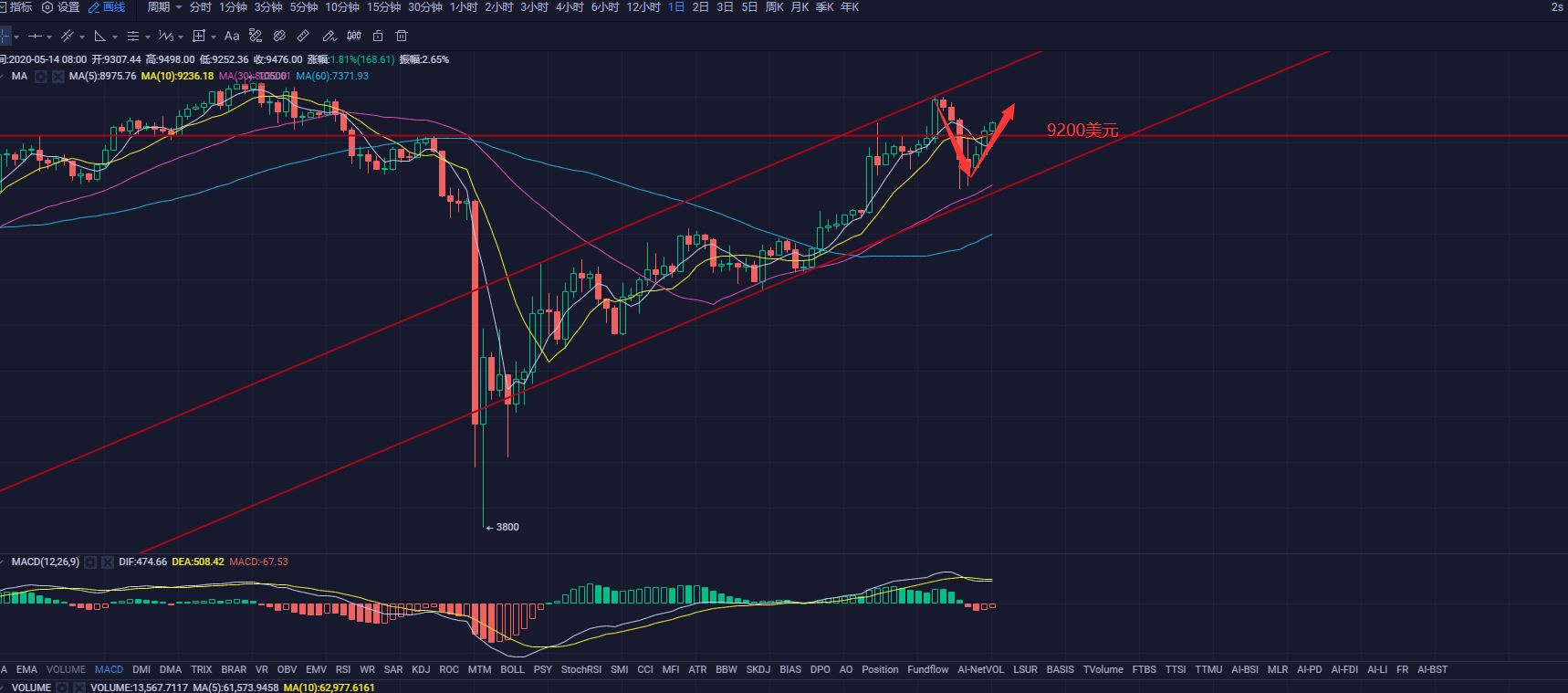
The daily structure looks bullish, with the correction seemingly reaffirming the prior uptrend. The key watchpoint remains resistance near the previous high. While the V-shape supports short-term optimism, we must watch for a potential double-top formation if price fails to make a new high. Pullback entries (as previously discussed) remain valid, but position sizing should stay conservative.
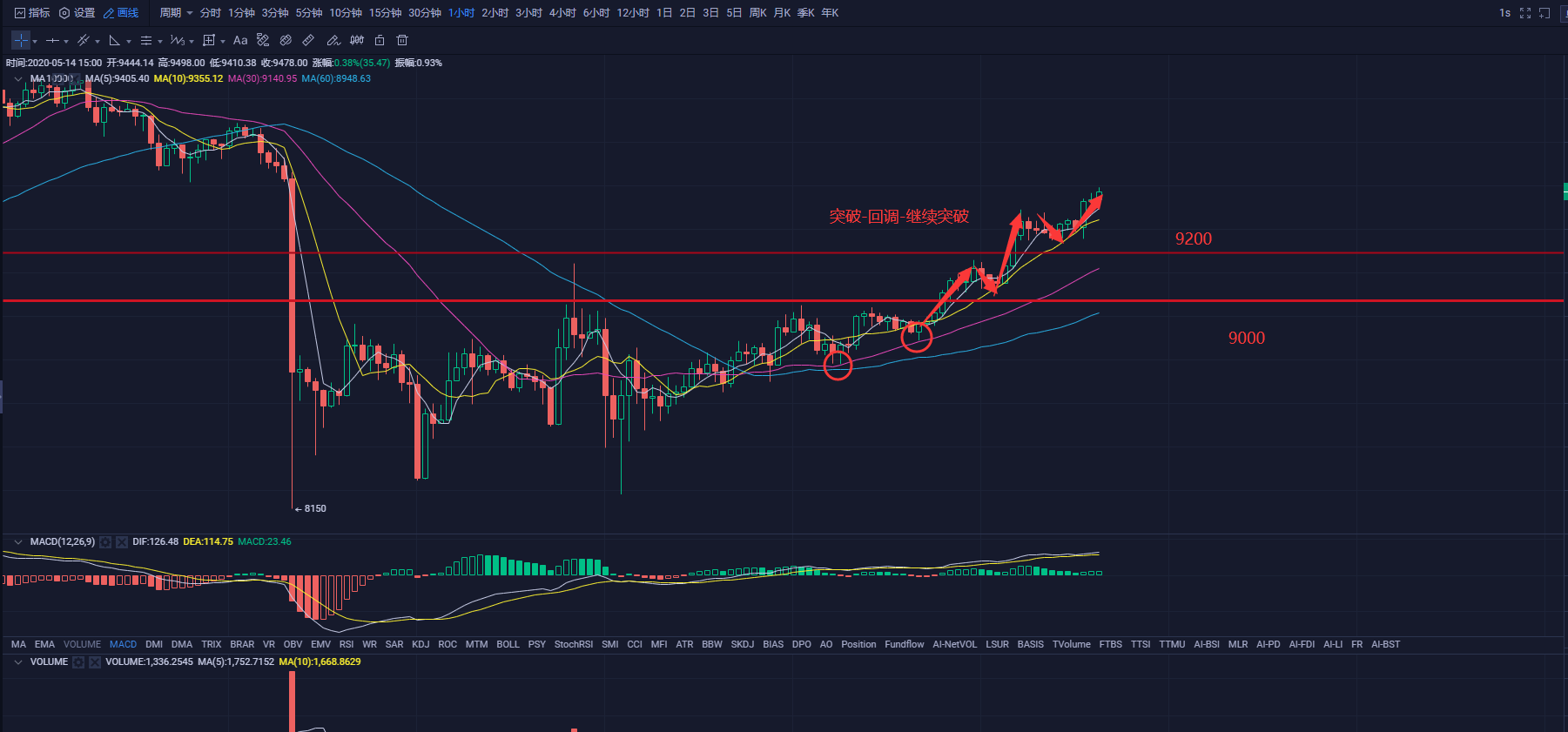
The hourly chart shows a clear rhythm: rally, pullback, rally. Each leg typically initiates after breaking a key level, forming a classic bullish structure.

Note the importance of pullback depth. Historically, hourly rallies that only ride the 5 or 10-day moving averages lack sustainability. Deeper pullbacks to test the 30-day MA are more common before the next directional move is decided.
Price is currently testing the $9,500 level. A decisive hold above $9,500 would significantly clear the path to $10,000, as the $9,500–$10,000 zone shows little historical resistance. A confirmed break above $9,500 would therefore face minimal hurdles on the way to $10,000, barring a double-top formation. While the double-top risk requires vigilance, it is not the primary trend; the dominant direction remains aligned with the broader uptrend.