
Author: Techub Exclusive Interview
On May 21, Hong Kong’s Legislative Council passed the Stablecoin Bill (the “Bill”). This legislation formally establishes a licensing regime for fiat-backed stablecoin issuers in Hong Kong, marking another significant step forward for the region’s stablecoin ecosystem.
Stablecoins are digital currencies pegged to stable assets. Their relatively low volatility makes them better suited for everyday transactions and payments. To date, jurisdictions including the United States, the European Union, the United Kingdom, Japan, and Singapore have all explored the use of stablecoins for payments.
As a leading hub for financial innovation in Asia, the Hong Kong SAR Government announced in December 2023 its plan to introduce a licensing framework for fiat-backed stablecoin issuers—a process that has since advanced steadily.
In July 2024, JD Blockchain Technology was selected as one of the first participants in the Hong Kong Monetary Authority’s (HKMA) “Stablecoin Sandbox,” placing the company among the most closely watched in the space.
At this industry milestone, Liu Peng, CEO of JD Blockchain Technology, shared his perspective on what the Bill’s passage means for the broader sector.
Q: What’s your take on the passage of the Bill? What does it signify, and what are its core regulatory provisions? As an early participant in Hong Kong’s Stablecoin Issuer Sandbox, what are JD Stablecoin’s next steps?
Liu Peng: The passage of the Stablecoin Bill formally brings stablecoins—as virtual assets—under Hong Kong’s rule-of-law regulatory framework. It creates a sound institutional environment for the healthy and sustainable development of the local stablecoin market. As HKMA Chief Executive Eddie Yue noted: “The Bill establishes a risk-based, pragmatic, and flexible regulatory regime. We believe a robust and appropriate regulatory environment will help foster the healthy, responsible, and sustainable growth of Hong Kong’s stablecoin ecosystem and the broader digital asset landscape.” This is also a landmark development for the global cryptocurrency industry.
The Bill provides a concrete regulatory framework covering several key areas: First, strengthened reserve management—licensed issuers must maintain high-quality, highly liquid reserve assets and ensure stablecoins can be redeemed at face value in a timely manner. Second, investor protection—stablecoin holders have the right to redeem their tokens at par, with redemptions processed within a reasonable timeframe. Third, comprehensive risk management—this includes anti-money laundering (AML) compliance, risk mitigation, disclosure requirements, audits, and suitability standards for key personnel.
As a participant in Hong Kong’s Stablecoin Issuer Sandbox, JD Blockchain will strictly adhere to the Bill’s provisions. We will actively collaborate with global partners and regulators to deploy stablecoins across more real-world use cases and help build an industrial ecosystem that supports healthy, compliant, and sustainable growth.
Q: JD Blockchain Technology has attracted significant attention amid Hong Kong’s stablecoin developments. What motivated you to launch this business?
Liu Peng: Guided by JD Group’s overseas business strategy, our team conducted in-depth research into the Web3 space. We found that issuing payment-oriented stablecoins via blockchain technology could not only address our own cross-border settlement challenges but also effectively serve other enterprises and the real economy—delivering substantial economic and social value. At the same time, the Hong Kong government has been actively supporting the Web3 industry.
Based on this assessment, we promptly applied for a license in Hong Kong. After about a year of effort, we were honored to gain regulatory recognition and join the Stablecoin Issuer Sandbox. We are now in close communication with the HKMA and regulators in other jurisdictions to advance the globally compliant operation of JD Stablecoin.
Q: Stablecoins have gained considerable attention in Hong Kong and elsewhere in recent years, yet they remain unfamiliar to many. Could you briefly explain what stablecoins are? What is JD Stablecoin’s current status, and what value does it offer?
Liu Peng: At their core, stablecoins are cryptocurrencies built on distributed ledger or blockchain technology and pegged to fiat currencies or other reserve assets.
They differ significantly from traditional cryptocurrencies. While BTC and ETH can serve as stores of value and mediums of exchange, their high volatility prevents them from functioning as reliable units of account or means of payment. Stablecoins address these gaps in the digital currency landscape, combining certain monetary attributes with the technical advantages of digital assets. As a result, they have quickly emerged as leading payment tools, attracting growing global discussion and adoption.
JD Stablecoin is a stablecoin issued on a public blockchain and pegged 1:1 to fiat currencies such as the Hong Kong Dollar (HKD) or US Dollar (USD). Initially, it will be issued in HKD- and USD-pegged versions, subject to regulatory approval and market demand. JD Stablecoin is not limited to JD’s internal ecosystem; it aims to provide businesses and individuals worldwide with a more efficient, cost-effective, and secure payment infrastructure. It has not yet officially launched and is currently in Phase Two of sandbox testing, during which mobile and PC applications will be offered to retail and institutional users. Test scenarios include cross-border payments, investment trading, and retail payments.
In cross-border payments, JD Stablecoin offers speed—reducing transaction times from days to minutes or even seconds; cost efficiency—by cutting out intermediaries and lowering fees; and a superior user experience—enabling 24/7 uninterrupted payment services. These features make it particularly well-suited for international trade settlements.
For investment trading, we are partnering with leading compliant exchanges. For retail payments, we are integrating and testing with merchant-acquiring platforms such as JD’s Hong Kong & Macau site. We also welcome more high-quality partners to join us in co-building the stablecoin ecosystem and sharing in the growth of the Web3 industry.
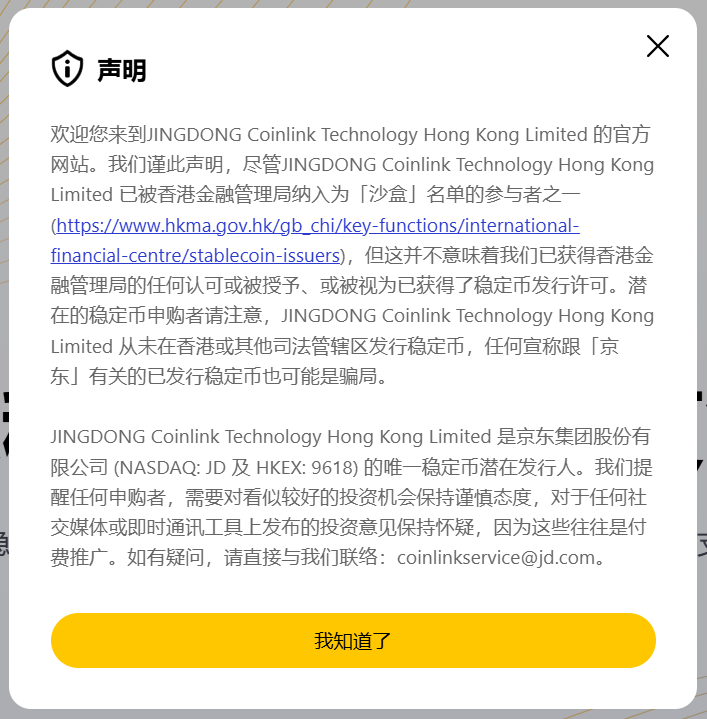
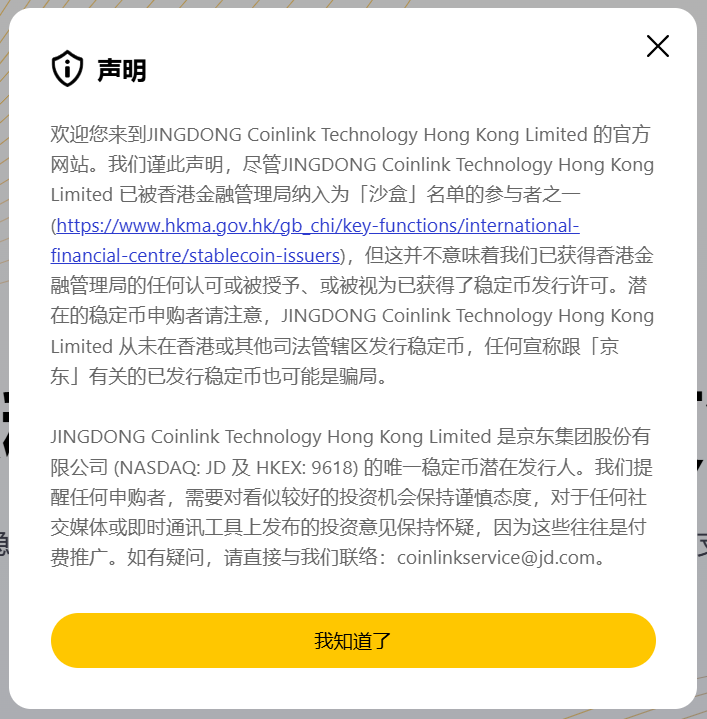
We would like to remind the public that JD Stablecoin has not yet officially launched, and there are no authorized channels for purchasing it. Any claims to the contrary are misleading and potentially fraudulent. For the latest updates on JD Stablecoin, please search for “JD Blockchain Technology.”
Q: What measures has JD Stablecoin implemented to ensure compliance and security?
Liu Peng: Compliance and security are the foundation of market acceptance and trust in JD Stablecoin—and a key competitive advantage for us. We consistently prioritize security, compliance, and risk control. We strictly adhere to stablecoin regulations, AML laws, and related requirements in Hong Kong and other relevant jurisdictions. Through a three-tier defense mechanism, we have established a multi-dimensional risk control system that includes on-chain tracking, real-time transaction monitoring, full-reserve asset custody, third-party audits, and smart contract audits.