
As Bitcoin surges past $23,000, another major piece of bullish news has hit the crypto market: the world's first cryptocurrency exchange has filed for an IPO.
Rumors had been swirling for some time that Coinbase was preparing to go public. Those rumors were recently confirmed when the company officially announced it has filed a registration statement for an initial public offering (IPO) with the U.S. Securities and Exchange Commission (SEC), putting it on track to become the first major crypto exchange to list on a public market.
While many investors outside the U.S. cannot trade directly on Coinbase (without using workarounds), the exchange is a household name. Founded in 2012, Coinbase emerged around the same time as the now-infamous Mt. Gox, roughly two years after Bitcoin's creation. Today, Coinbase serves over 35 million users and is the largest cryptocurrency exchange in the United States by trading volume, as well as one of the largest globally. It is now poised to make history as the first publicly listed crypto exchange.
Coinbase stated it confidentially submitted a draft registration statement on Form S-1 to the SEC. The company's latest valuation is approximately $8 billion.
The timing of Coinbase's IPO move is strategic. Bitcoin is on a powerful rally, and traditional financial institutions are increasingly entering the crypto space. Launching an IPO now would likely generate strong demand for its stock, especially given these institutions' keen awareness of market trends.
However, crypto exchange IPOs face clear challenges. A key question is whether their stock prices will closely track cryptocurrency prices. In a bull market like the current one, rising Bitcoin prices could lift exchange stocks. But in a bear market, depressed crypto prices could trigger significant stock volatility. After all, an exchange's most valuable asset is its user base, and user activity fluctuates with market sentiment. If Coinbase goes public, we could see a feedback loop where exchange stock prices and cryptocurrency prices influence each other.
Given the ongoing bull market, Coinbase's post-IPO performance looks promising. This development also highlights a new asset category worth watching: platform tokens.
As a trading platform, Coinbase shares the same core function as exchanges like Binance, OKX, and Huobi. If investor excitement over Coinbase's stock reveals that the market has undervalued exchanges, could this spark increased demand for other platforms' native tokens?
Speaking of exchanges, recent market activity is noteworthy. After Bitcoin broke above $20,000, a wave of retail investors flooded the market, causing slowdowns or outages at several major digital asset exchanges, including Binance and Huobi.
On the evening Bitcoin surpassed $20,000, Binance CEO Changpeng Zhao tweeted that platform traffic had surged 30-fold, causing scalability issues and latency, which required adding more servers.
Exchange outages are a minor concern—they happen frequently during periods of extreme volatility. What matters more is the changing makeup of market participants. Since at least the second half of this year, institutional investors have been the primary drivers of the rally. Their reliable, large-scale capital reduces the risk of a sudden market collapse.
However, with Bitcoin now above $20,000, retail participation has spiked dramatically—a shift that demands close attention. Financial markets are a zero-sum game between large players ("whales") and retail investors, where whales profit from less-informed traders. If retail investors keep pouring in while prices rise, they ultimately eat into the whales' profits—a situation whales will try to avoid.
Therefore, going forward, we must closely monitor market sentiment and retail inflows. A continued surge in retail participation should raise caution about near-term price action—while it doesn't guarantee an immediate crash, a correction becomes more likely.
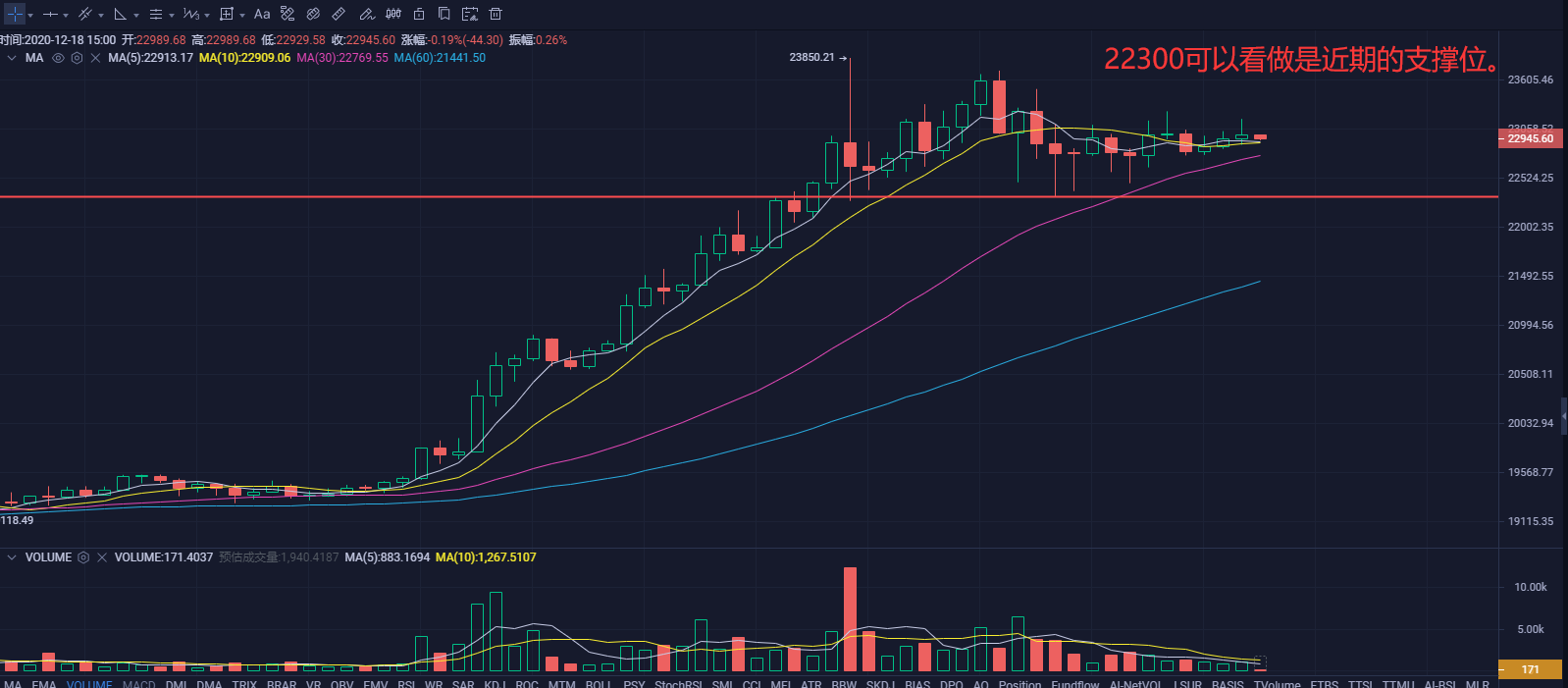
Turning to price action: yesterday, Bitcoin not only tested new highs but also repeatedly retraced to test support levels below, managing to hold above $22,000. After some oscillation, the price is now consolidating around $23,000.
Intraday price action remains range-bound with wide swings. Although volatility has temporarily eased, no clear directional bias has emerged. With the weekend approaching, traders should first assess recent consolidation patterns and watch whether Bitcoin can sustainably hold above $23,000.
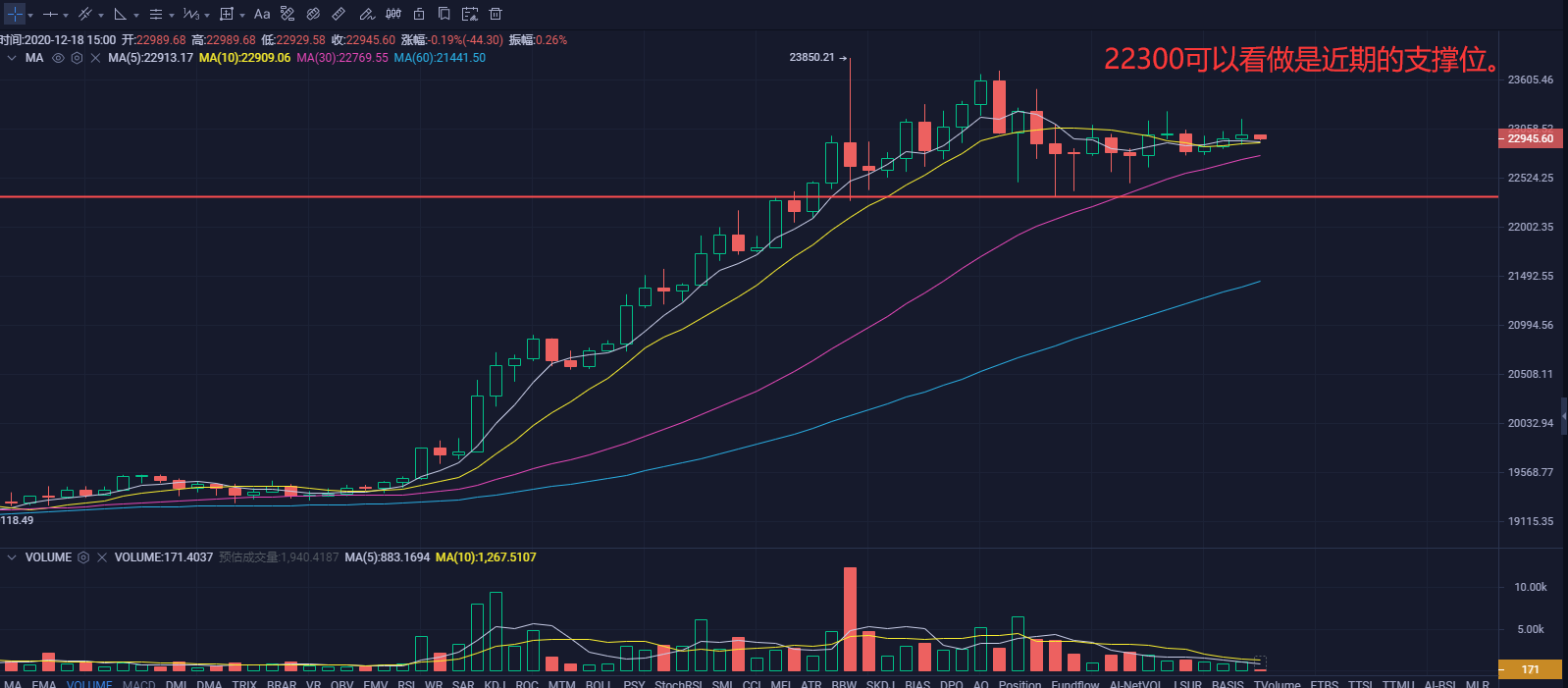
The current challenge is that Bitcoin continues to set new all-time highs, leaving no prior price levels for reference and severely limiting available technical information. This heightened uncertainty means we need to let the market develop further before identifying key support zones or areas of selling pressure.
Of course, a popular market view is that "above all-time highs, the sky's the limit"—a perspective that makes sense from a pure trend-following standpoint. But no market rises forever, and investors must always consider risk: could they get caught in a downturn? This highlights the importance of choosing the right entry points. Currently, the $22,300 zone has been tested and validated, making it a meaningful near-term support level.
Major Coins: Most major cryptocurrencies are currently stuck in a pattern of "following the drop but missing the rally"—they lag when the market rises and fall harder than BTC during corrections. This was evident during yesterday's BTC pullback. The notable exception is LTC, which has shown surprising strength, even hitting a new all-time high today and outperforming both its peers and BTC. Litecoin remains a coin worth watching for the long term.